


Lean manufacturing has been the industry’s North Star for decades, helping titans like Toyota redefine what it means to achieve operational excellence. But then why do so many Lean initiatives stall out in the real world?
The reason? The infrastructure is often obsolete.
Many companies are asking 21st-century teams to achieve split-second efficiency using manual tools that belong in a museum. Lean isn't failing because the philosophy is flawed; it’s failing because it is being squeezed by the very manual processes it aims to eliminate.

The Lean Method
The foundation of lean manufacturing is a set of powerful, unambiguous principles. Lean focuses on:
- Visibility
- Consistency
- Continuous Improvement
They appear simple on paper. However, they are significantly more difficult to achieve in reality. Let’s take a look at these four areas of focus and see what teams need to ensure their lean initiatives don’t fail.
1. Visibility: Data-Driven Decision Making
Lean relies on real-time operational awareness and fact-based decision-making. Teams need to understand clearly:
- Where each task is in the process.
- Which steps are taking longer than expected.
- Where defects or delays are happening.
- Key metrics like cycle times, error rates, and bottlenecks.
Without strong visibility, problems remain hidden until it’s too late. In many environments, data is still captured manually. This makes visibility incomplete, delayed, or inaccurate.
This creates blind spots where inefficiencies grow unnoticed, and decisions end up based on assumptions rather than facts.
True lean visibility means capturing accurate data in real time, directly tied to specific processes and steps. When data is easy to access and act on, teams can move from reactive fixes to proactive optimization.
2. Consistency: Doing It the Right Way, Every Time
Consistency in lean manufacturing goes beyond standardizing operator tasks; it applies to processes, quality, and decision-making across the entire operation.
Without it, variation creeps in: shortcuts develop, processes drift, and results become unpredictable. In many environments, consistency relies too much on memory or habits, leading to uneven performance.
Lean addresses this by building consistency directly into each process. This results in more reliable quality, faster training, and better overall performance.
3. Continuous Improvement: Turning Insights into Action
Improvement is only effective if there is a methodical approach. This methodical approach needs to:
- Identify issues
- Capture feedback
- Implement changes
- Sustain those changes over time
Without this approach, efforts to develop become one-time efforts rather than long-term initiatives. Many businesses want change, but improvement efforts are disorganized and get no further than meetings, emails, and casual discussions.
Consequently:
- Good ideas are lost.
- Changes aren’t standardized.
- Old habits return.
A digital system where each improvement is recorded, implemented, and reinforced is necessary for true continuous improvement.
When Lean Fails Without Digital Support
Reason 1. When Standard Work Isn’t Actually Standardized
Standard work serves as the basis of Lean Manufacturing. However, when instructions are stored in binders or outdated PDFs, operators frequently:
- Don’t know where to find them.
- Use memory instead.
- Follow “how it’s always been done”.
The outcome? Processes differ depending on the individual, shift, and/or place.
For companies experiencing these issues, standard work exists in theory, but not in practice. They may have systems or methods in place, but the wheels are not making contact with the road. Workers do not have the resources they need to achieve the Lean goals of the company.
The solution? Turn standard work into standard practice.
The solution isn’t more documentation, more training sessions, or stricter enforcement. It’s giving operators the tools they need to execute standard work naturally and consistently in their daily workflow.
Digital platforms like work instructions software help companies embed standard work directly into the production process. Rather than depending on static documents or memory, operators are guided in real time by:
- Visual, step-by-step instructions tailored to the task at hand.
- Automatic prompts for critical steps and quality checks.
- Instant access to the most up-to-date process revisions.
This transforms standard work from something that’s referenced occasionally into something that’s followed every time.
Most importantly, Lean stops being something teams try to follow and becomes something they execute effortlessly. That’s the difference between having standard work on paper and bringing it to life with digital tools.
Digitizing standard work moves it out of the binder and into the flow of work. When instructions are embedded into daily operations, the process becomes:
- Accessible & Actionable: Instructions are delivered exactly when and where they are needed—at the workstation. By building guidance directly into the workflow, you ensure that following the "best way" is the only way.
- Adaptive & Scalable: Processes can be updated centrally and deployed across the shop floor instantly. This alignment eliminates version-control errors, slashes training time, and ensures that continuous improvement gains immediate momentum across every shift.
Reason 2. When There Is No Real-Time Visibility on the Shop Floor
Lean relies on understanding:
- Real-time job status
- Location of bottlenecks
- Point-of-occurrence issues
Feedback through paper-based systems is slow. In most cases, the feedback is only seen after production is already done.
By the time issues are identified:
- Defects have already been produced.
- Time has been wasted.
- Root causes are harder to identify.
So how can manufacturers obtain the visibility they need to get the most out of lean methods?
Real-time insight is made possible by digital tools, which enable teams to identify problems right away rather than days later.
The Solution? Implement digital and immediate data collection. By using digital tools that enable workers to collect and display data while the work is being done, companies supercharge their insights and decision-making capabilities.
Again, an MES or a work instruction platform turns every action on the shop floor into a data point.
- The system automatically monitors completed quantities and time spent on each job.
- Quality checks and measurements are recorded instantly.
- Deviations, errors, or skipped steps are flagged immediately.
As a result, teams can rely on a real-time snapshot of production at any moment. This level of visibility enables modern companies to ensure that they are on track to hit their Lean goals.
Integrating real-time digital insight transforms the shop into a proactive operation:
- Actionable Visibility: Move beyond simple monitoring. Use real-time data to detect bottlenecks instantly, trigger automated corrective alerts, and stop defects at the source before they move downstream.
- Decentralized Problem Solving: Empower teams to resolve issues closer to the source. With live data, supervisors spend less time chasing status updates and more time making confident, data-driven decisions that sustain continuous improvement.
Reason 3. When Continuous Improvement Has No Feedback Loop
Feedback is essential to kaizen (continuous improvement). However, improvement ideas are rarely implemented when they remain in notebooks, emails, or conversations in the hallway.
- Changes aren’t documented
- Best practices aren’t shared
- Improvements aren’t enforced
Even when a better method is discovered, updates take time to document. Additionally, communication can be inconsistent across teams and shifts.
The Solution? Turn improvements into standard practice
A digital platform transforms Kaizen from an occasional event into a permanent, closed-loop process. By removing the friction between identifying an improvement and executing it, manufacturers can achieve true operational excellence:
- Instant, Frictionless Execution: Process enhancements can be deployed in minutes rather than weeks. When an engineer updates a central instruction, the change is published instantly to every workstation.
- Built-in Traceability & Verification: Closing the loop requires data to prove an improvement actually worked. This allows teams to verify if a change reduced errors or improved cycle times.
-Automated Sustainability: By embedding best practices directly into the daily workflow, the system itself sustains the progress. Knowledge is captured and shared across every shift and location, ensuring that continuous improvement becomes a seamless part of the job.
Lean becomes a closed-loop process when improvements are recorded, implemented, and maintained within a single digital system:
- Identify
- Improve
- Standardize
- Sustain
- Repeat
That’s how manufacturers move from occasional improvements to continuous, scalable operational excellence.
Reason 4. When Training Becomes Inconsistent and Inefficient
Training is essential in lean environments, where operators must quickly learn new tasks, rotate between roles, and adapt to evolving processes.
Training that relies on paper or memory causes:
- Poor memory retention
- Inconsistent methods
- Longer training periods
Some skilled operators possess crucial expertise in many production settings. They are aware of the nuances, shortcuts, and minor tweaks that ensure smooth operations.
This is what's commonly called "tribal knowledge," and although it's valuable, it's hard to scale or maintain. This poses a risk:
- Training depends heavily on who is available to teach
- Knowledge is transferred inconsistently
- Expertise is lost when employees leave or retire
The Solution? Capture knowledge and scale it across the workforce.
Platforms for digital work instructions, such as VKS, convert the knowledge into an organized, repeatable, and accessible method.
In many Lean environments, training is informal and relies heavily on "shadowing" experienced operators. This creates a reliance on tribal knowledge, where critical expertise is trapped in individual heads. Digital work instructions reduce dependence on experienced operators and tribal knowledge while standardizing training throughout the workforce.
- Faster Onboarding & Flexibility: New hires and cross-trained employees become productive faster by learning directly at the workstation. This reduces the burden on senior staff and allows for greater workforce agility during role rotations or labor shortages.
- From Shadowing to Guided Work: Instead of verbal instructions that vary by shift, operators are led by visual, step-by-step procedures with built-in quality checkpoints. This ensures a best-practice approach is followed by every operator, regardless of their experience level.
- Knowledge as a Living Asset: When a process evolves, the update is shared across every shift and facility instantly. This creates a resilient, scalable workforce that functions as a single unit rather than a collection of siloed experts.
Lean Manufacturing Needs a Digital Backbone
Lean was never intended to be stagnant. While it is a powerful methodology and practice, it cannot stand on its own. It is dependent on:
- Accurate data
- Fast feedback
- Consistent execution
- Flexible and responsive systems
Digital tools don’t replace Lean principles; they enable them. Think of it this way:
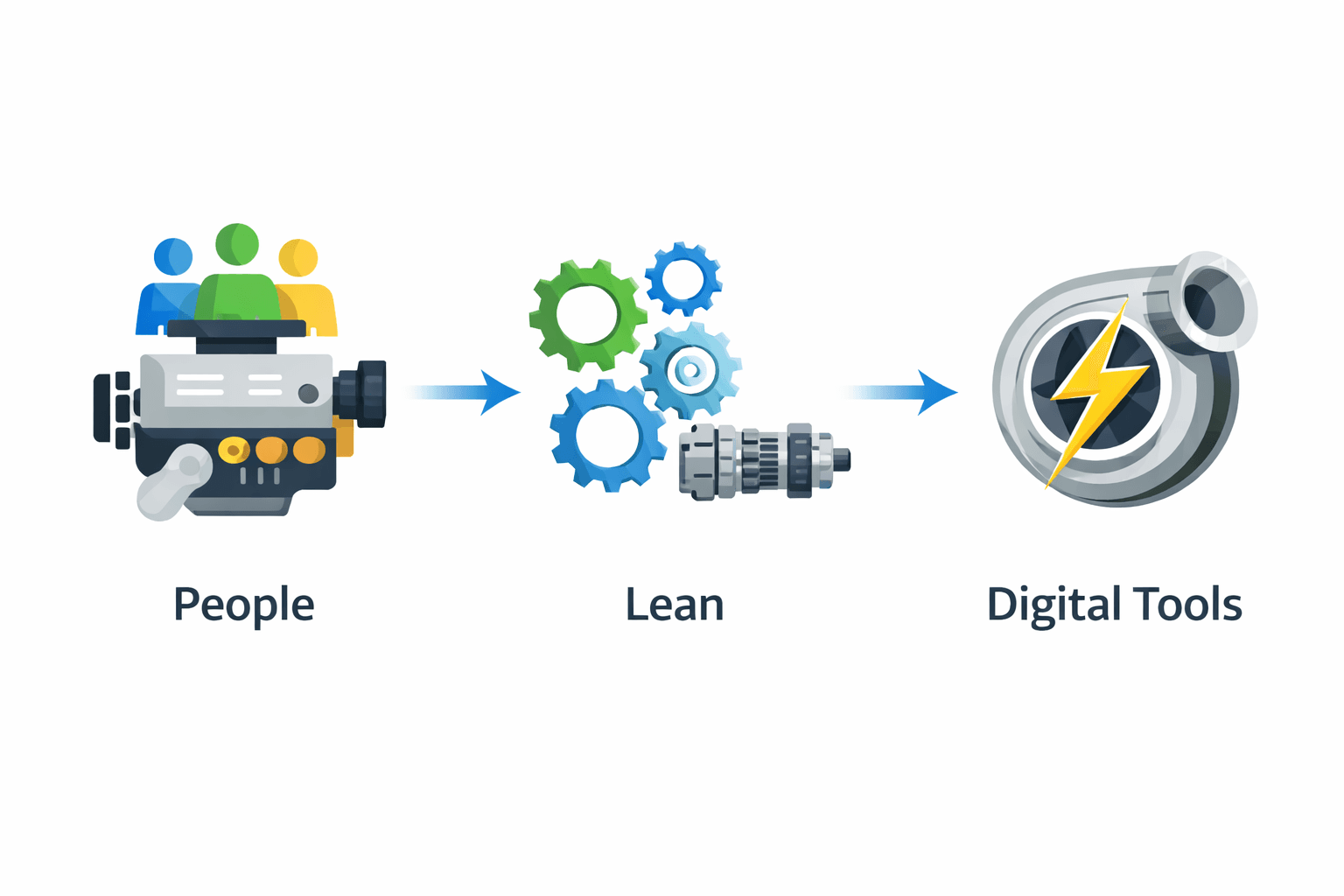
The people are the engine driving the car forward. Lean principles serve as the transmission and steering, ensuring power is transferred efficiently without waste. Digital tools are the turbocharger, allowing the vehicle to cover the same ground in a fraction of the time.
Lean is turbocharged by digital tools in the following areas:
- Delivering standardized, visual work instructions directly to the operator.
- Capturing real-time production data and feedback.
- Enforcing best practices across shifts and sites.
- Supporting traceability, compliance, and continuous improvement.
Without digital support, lean becomes inconsistent, manual, and brittle. With the correct digital tools, lean becomes measurable, scalable, and resilient.
Lean Doesn't Fail; The Tools Do
For organizations wondering why Lean manufacturing fails, the answer is often not a lack of effort, but a lack of infrastructure that supports Lean principles in real time.
While Lean manufacturing provides the principles needed to drive efficiency and eliminate waste, the sections above highlight a recurring theme behind why Lean fails and why Lean manufacturing fails in modern environments: execution gaps caused by outdated systems.
Across every challenge, from inconsistent standard work to lack of visibility, broken feedback loops, inefficient training, and weak traceability. The solution points to the same conclusion:
Digital tools are what transform Lean from theory into reality.
Platforms such as VKS work instruction software allow manufacturers to:
- Turn standard work into standard practice through real-time, guided execution.
- Replace delayed reporting with real-time visibility and immediate action.
- Close the loop on continuous improvement by capturing, deploying, and sustaining changes.
- Standardize training while reducing reliance on tribal knowledge.
- Ensure full traceability and become audit-ready at all times.
In other words, digital tools like VKS don’t just support Lean manufacturing; they enable it at scale.
FAQs:
Why does Lean fail without digital tools?
Lean often fails because companies attempt to apply its principles using manual, outdated systems. Without digital tools, it becomes difficult to maintain visibility, consistency, and continuous improvement, which are essential to Lean success.
Why does lean manufacturing fail even when teams are trained?
Even with proper training, Lean manufacturing can fail if execution relies on memory, paper instructions, or inconsistent processes. Without systems that reinforce standard work in real time, variation and inefficiencies return quickly.
How do digital tools improve lean manufacturing?
Digital tools improve lean manufacturing by:
- Providing real-time visibility into operations.
- Standardizing work instructions.
- Capturing accurate production data.
- Enabling faster decision-making.
- Supporting continuous improvement.
They help teams move from reactive problem-solving to proactive optimization.
What role does VKS play in Lean manufacturing?
VKS acts as a digital backbone for Lean by delivering interactive work instructions, capturing real-time data, and ensuring process consistency. It helps manufacturers sustain improvements and scale Lean initiatives effectively.
What are the biggest signs that Lean is failing?
Common signs include:
- Inconsistent processes across operators or shifts.
- Lack of real-time visibility.
- Repeated errors or rework.
- Slow or ineffective training.
- Difficulty passing audits or tracking compliance.
These are often indicators that digital support is missing.