01
Inconsistent Processes
Operators rely on memory, tribal knowledge, or outdated documents.
The Connected Worker Platform leverages interactive digital instructions and IIoT to provide shop floors with standardized execution, real-time data capture, and built-in defect prevention.
See VKS in Action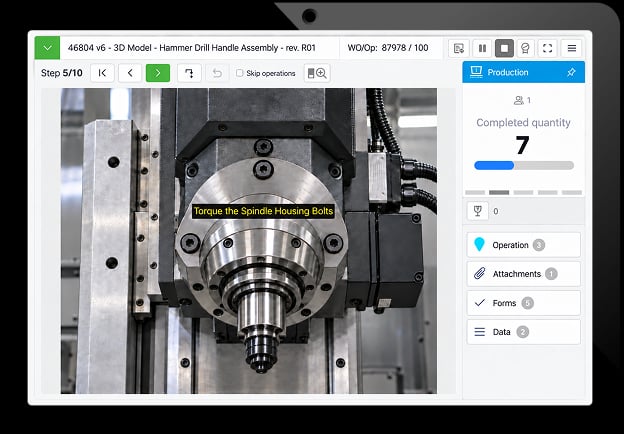
Replace paper and memory with dynamic digital guidance.
Ensure consistency across every shift.
Automate data collection to enhance and simplify shop floor metrics.
Lock out defects at the source so errors never travel downstream.
Why paper and isolated basic systems fail to support the modern factory.
Operators rely on memory, tribal knowledge, or outdated documents.
People, machines, and production systems operate in silos.
Critical production data arrives late or is never captured.
Problems move downstream before corrective action happens.
VKS takes work instructions further by enhancing the operator with IIoT connected devices/sensors, auto-data collection, and seamless communication with other enterprise software, providing you with the frontline interface operations need.
Dynamic and visual workflows guide workers and adapt in real time to worker inputs, machine signals, and step conditions.
Automated quality checks lock out defects in real time before the next step occurs by syncing directly to live machine cycles.
Automated sensor-driven data capture eliminates manual entry while providing real-time, floor-wide visibility into cell health.
Interactive visual guides standardize procedures to eliminate dense text binders and ensure consistent execution across teams.
Connected equipment and IoT sensors stream real-time data to automate step navigation and error-proof worker activities.
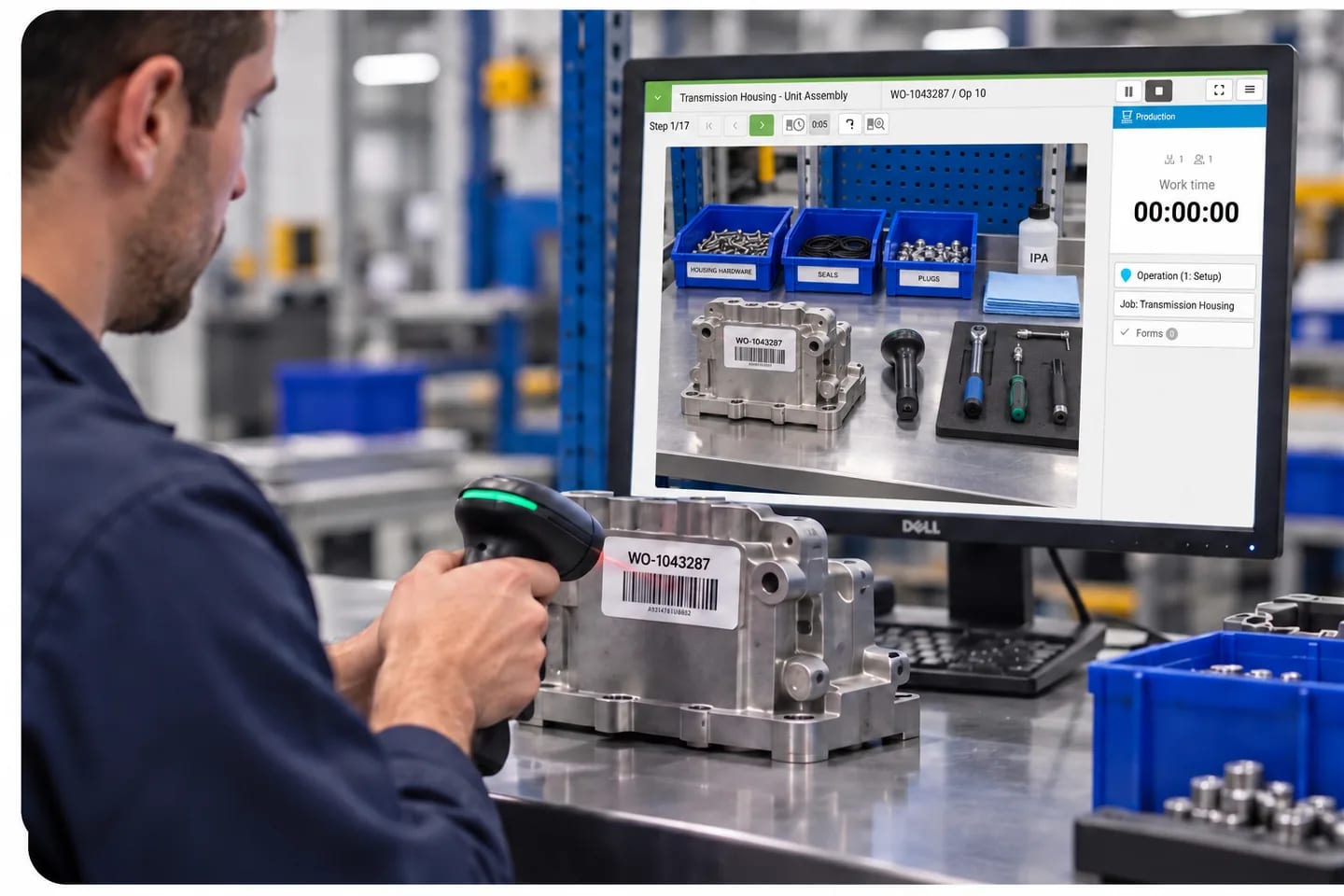
In Action: The worker scans a barcode at their workstation to automatically open the correct work instructions.
See how a connected worker platform adapts to strict regulatory
standards and complex assembly demands.
Guarantee total traceability with zero-defect tool integration and automated AS9100 step validation.
Explore AerospaceEliminate downtime with sensor-driven error-proofing (Poka-Yoke) built into every workflow.
Explore Industrial MachineryEnforce strict takt times, sequential build precision, and instant operator alerts.
Explore TransportationAutomatically create, sign, and validate Electronic Device History Records (eDHRs) as work happens.
Explore Medical DevicesWhether you are looking to deep-dive into our product capabilities or want a tailored
walkthrough of the platform, we have a path for you.
Traditional paper or static digital instructions rely entirely on the operator to read, recall, and manually confirm every step. Because disconnected systems cannot monitor the physical workspace or communicate with tools, they cannot stop human error in real time—leading to missed steps, costly rework, and scrap.
Traditional setups keep operators isolated, requiring constant screen interactions and manual data logging. A connected worker platform links operators directly to smart tools, sensors, PLCs, and enterprise software. It automatically advances instructions based on physical movement, captures operational metrics effortlessly, and locks out defects before they can occur.
Yes. Connected worker platforms are built to sit directly on top of your existing physical infrastructure. By adding lightweight sensors, pick-to-light modules, or smart tool integrations to your current stations, you can transition to a fully connected environment without re-architecting your assembly lines.
The platform synchronizes digital guidance with physical equipment and machine cycles. For instance, it can trigger mandatory inspection prompts after a set number of units, or prevent an operator from progressing until a connected torque tool confirms a fastener was tightened to exact specs. This makes execution and quality verification happen simultaneously.