01
Disconnected Machines & Tools
Equipment operates in isolation, with no awareness of the active work step or operator workflow.
Traditional workstations are passive. Discover how IIoT and VKS workstations transform the way your operators interact with machines, data, and physical manufacturing space.
See VKS in Action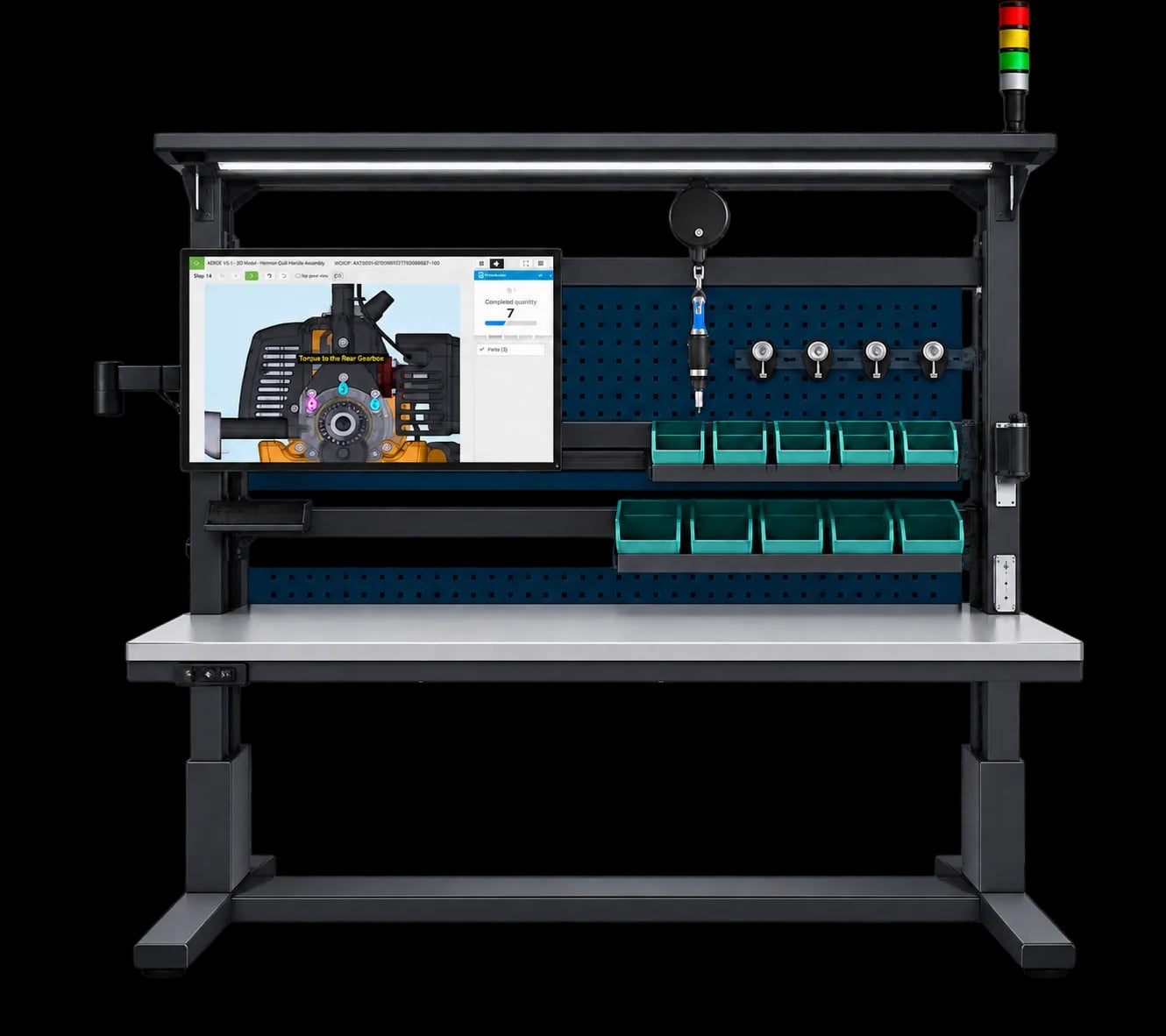
Advance work instructions automatically based on connected sensors and operator movement.
Capture torque values, unit counts, QC sensor measurements, and more.
Use andon lights, pick to lights sensors and more, to visually guide operators through tasks and activities.
Integrate smart tooling and hardware sensors to guarantee total error-proofing.
A traditional work station cannot see what the operator, tool, machine, and process are doing together.
Equipment operates in isolation, with no awareness of the active work step or operator workflow.
Torque values, counts, measurements, and inspection results depend on operators recording data by hand.
Traditional workstations cannot verify that parts, tools, or process conditions are correct before work continues.
Supervisors lack immediate insight into workstation status, production issues, and where support is needed.
Industrial Internet of Things (IIoT) technology in manufacturing is a network of connected shop-floor hardware. This includes smart tools, PLCs, spatial lighting, and quality sensors. By integrating devices and equipment directly into interactive work instructions, IIoT automatically captures real-time production metrics, streamlines operator steps, validates assembly actions, and eliminates defects.
Smart tools auto-capture values, verify torque specs in real time, and block step advancement if readings are out-of-spec.
Provides responsive, visual work instructions via a modern, intuitive touch UI designed specifically for smooth operator flow.
Tracks unit counts and intervals, automatically interrupting workflows to prompt and enforce required QC forms.
Work instruction steps advance automatically as connected tools, scanners, or PLCs send successful execution signals.
See the immersive IIoT Workstation
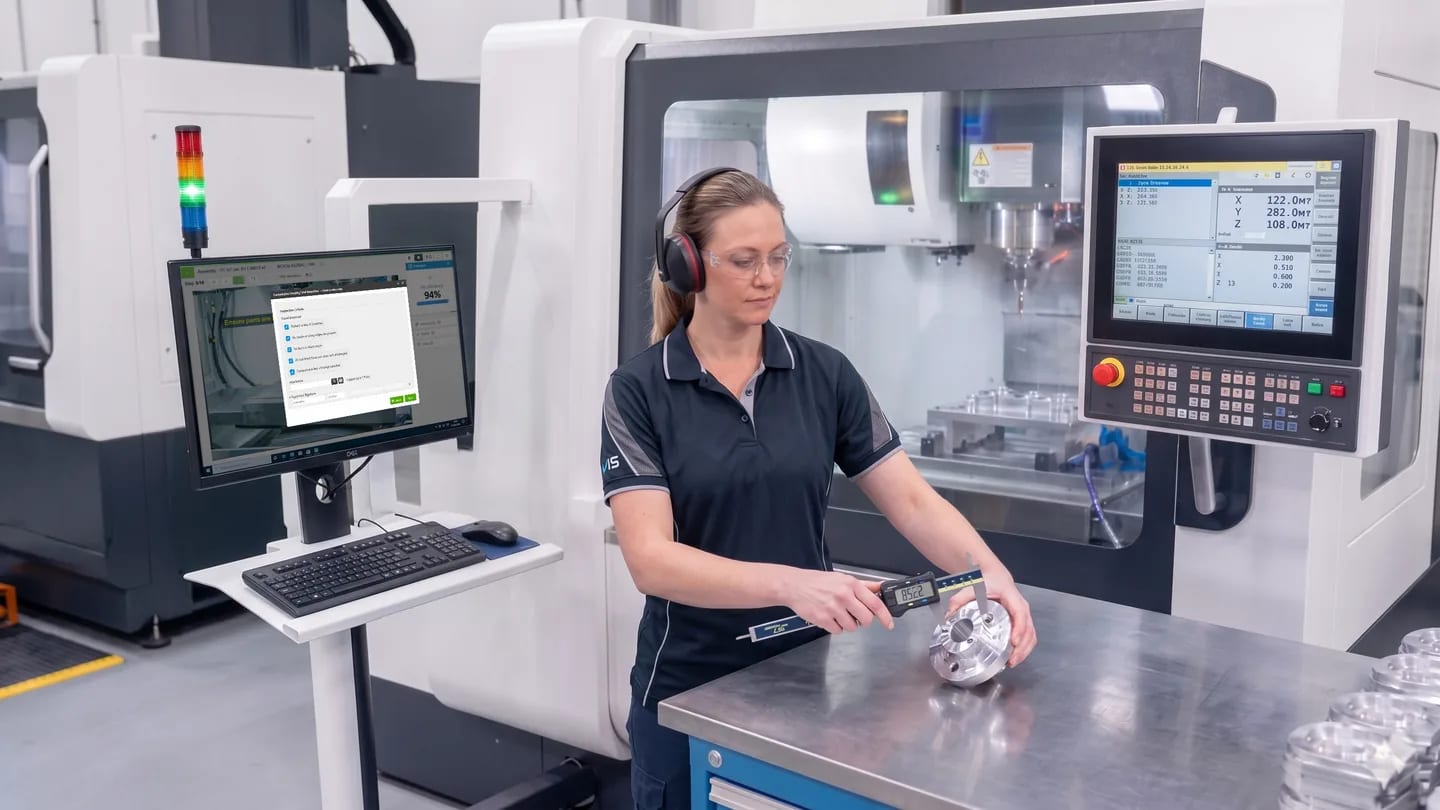
In Action: Machine counts trigger automated QC prompts and Andon alerts, capturing completed units and ensuring defect-free output.
See how a connected worker platform adapts to strict regulatory
standards and complex assembly demands.
Zero-defect tool integration and strict AS9100 step validation.
Explore AerospaceSensor-driven error-proofing (Poka-Yoke) to eliminate assembly downtime.
Explore Industrial MachineryEnforce takt time and sequential build precision.
Explore TransportationAutomatically create and validate Device History Record (eDHRs).
Explore Medical DevicesWhether you are looking to deep-dive into our product capabilities or want a tailored
walkthrough of the platform, we have a path for you.
Static work stations rely entirely on the operator to manually read, remember every procedural step. Because these setups cannot monitor the physical environment, they fail to prevent human error, safety risks, or missed steps. Errors are only caught after the fact during downstream inspections, leading to costly rework and scrap.
Traditional workstations are isolated and passive, requiring manual data entry and constant screen interaction. An interactive smart workstation, powered by VKS Edge, transforms the workspace into a reactive partner. By combining digital instructions with hardware like spatial lighting, pick-to-light systems, and smart tools, the environment automatically advances steps based on operator movement and locks out defects before they can happen.
Yes. Interactive workstations are engineered to take up the exact same physical floor space and hardware footprint as your current setup. By deploying photoelectric sensors, light curtains, and infrared cameras directly onto your existing stations, you can smoothly transition to hands-free manufacturing and zero-touch navigation without rebuilding your assembly line layout.
A smart workstation synchronizes digital guidance directly with machine cycles and smart tools to enforce strict process locks. For example, the station can automatically trigger mandatory inspection prompts based on real-time cycle counts, or use connected sensors to confirm material alignment and temperature before authorizing the next assembly step. This ensures that the work and validating the work happen simultaneously.