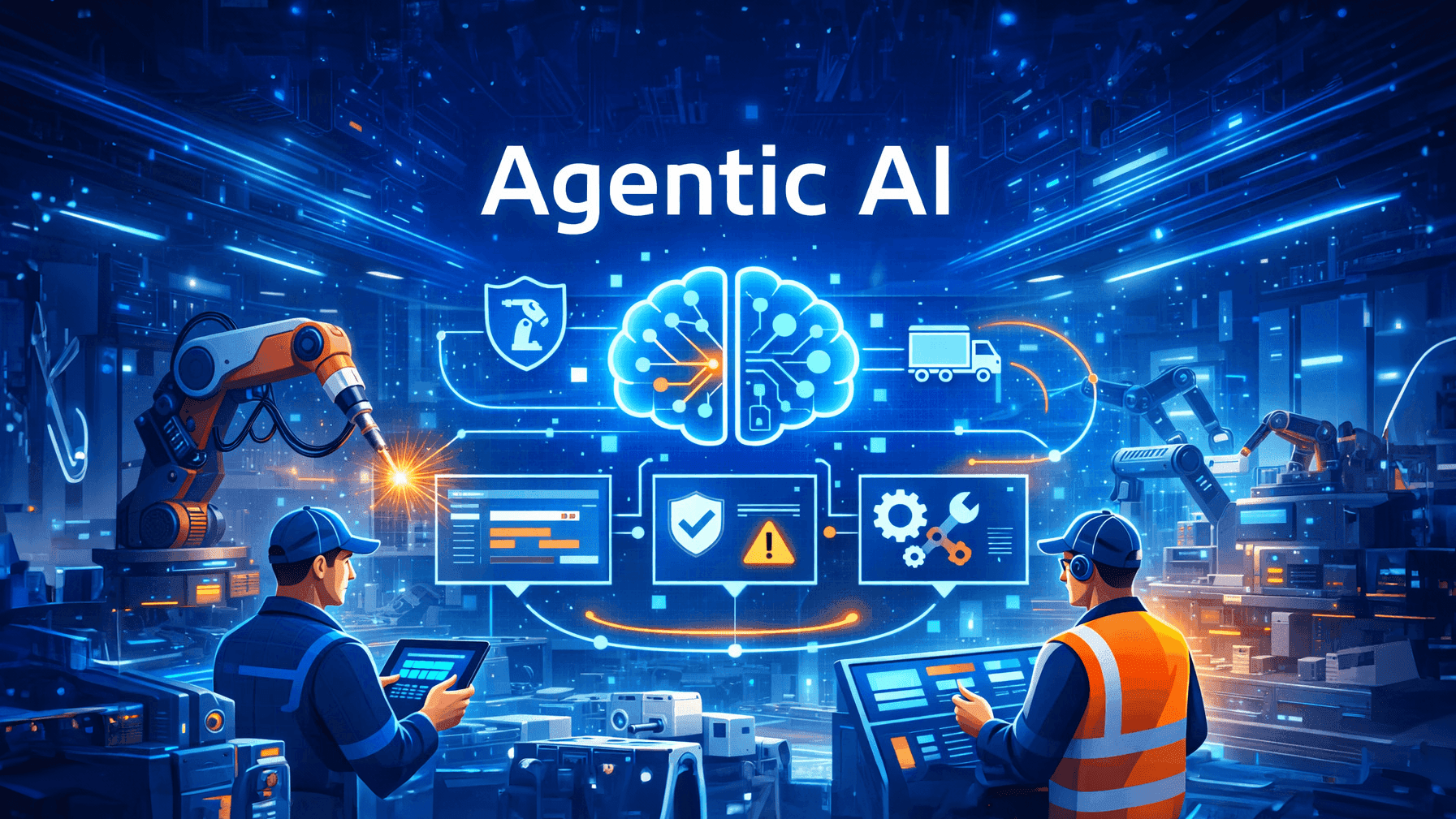


Manufacturers today are collecting more data than ever before.
Machines, sensors, operators, and various systems generate valuable information about how production is running. However, many companies still find it challenging to turn this data into useful decisions on the factory floor.
Agentic AI is the next step in smart manufacturing.
Unlike traditional AI that only analyzes data or makes predictions, agentic AI can sense what's happening. It can understand problems and take independent actions to meet operational goals.
In this article, we’ll explore what agentic AI means for manufacturing and dive into real use cases that are transforming factories. We’ll also explain why structured manufacturing execution data captured by frontline digital platforms is essential for unlocking its true value.
What Agentic AI Is and Why It Matters in 2026
Agentic AI goes beyond predictive or prescriptive analytics.
Traditional predictive systems alert you that a machine will eventually fail. But the benefits end there.
In contrast, an agentic AI system can autonomously evaluate that alert, schedule maintenance, update production plans, and inform relevant teams. These autonomous actions effectively close the loop without waiting for human intervention.
Here is a way to frame the difference clearly:
- Predictive systems indicate what might happen.
- Agentic AI systems act on behalf of the business goal, executing workflows across systems with minimal human input.
This capability matters enormously in manufacturing environments where teams must quickly make decisions to avoid downtime, quality issues, or supply disruptions.
Factories operate as highly connected systems. A machine failure can impact production scheduling, quality checks, inventory flow, and delivery timelines. Agentic AI can react to these effects much faster than traditional decision-making processes.
The result is a more resilient and adaptive production environment powered by AI-driven autonomous systems.
The Power of Agentic AI in Manufacturing

Agentic AI is starting to change how factories work by focusing on important areas like improving efficiency, quality, maintenance, and managing the supply chain.
Here are four key areas where this technology is generating excitement in the manufacturing industry:
1. Adaptive Production Scheduling
Rather than static schedules, agentic AI systems monitor real-time conditions (equipment status, material flow, labour availability) and adjust production plans autonomously. This AI-driven approach reduces idle machine time and ensures priority jobs stay on track.
Instead of relying on periodic manual updates, the AI system monitors:
- Machine performance and uptime
- Operator availability
- Work-in-progress levels
- Material availability
- Order priorities
When a disruption happens, the system can automatically generate an updated schedule designed to maintain throughput while minimizing delays.
For example, if a critical machine goes offline, the AI might:
- Reassign work orders to alternative equipment
- Adjust the sequence of production steps
- Alert maintenance teams
- Notify supervisors about potential delays
Because the system is constantly analyzing production data, these adjustments can happen almost instantly.
The impact is significant. Adaptive scheduling helps reduce idle machine time, prevents bottlenecks, and ensures high-priority orders stay on track even when disruptions occur.
2. Autonomous Quality Control
Quality management is another area where agentic AI shows significant potential. Traditional quality processes rely on periodic inspections and statistical sampling. While effective, these approaches can still allow defects to pass through the production process before detection.
Agentic AI can dramatically improve this by enabling continuous quality monitoring and autonomous corrective actions.
Advanced AI-driven systems can analyze production data in real time to identify patterns associated with defects. This might include machine settings, environmental conditions, material properties, or operator workflows.
When the system detects early indicators of a quality issue, it can automatically trigger actions such as:
- Adjust machine parameters
- Pause a production process
- Initiate additional inspection steps
- Alert quality engineers
This type of intelligent quality control can help manufacturers reach the goal of zero-defect manufacturing using autonomous systems.
3. Predictive and Proactive Maintenance
Agentic AI can forecast machine failures and orchestrate maintenance workflows. In a world where equipment reliability remains one of the biggest challenges in manufacturing operations, this advancement is crucial.
Unplanned downtime can halt production, disrupt supply chains, and create costly delays. Predictive maintenance technologies have already helped reduce these risks by forecasting equipment failures before they occur.
Agentic AI adaptation takes this further by enabling AI-driven orchestration of maintenance workflows.
When an AI system detects abnormal machine behavior, such as temperature increases or cycle anomalies, it can automatically begin maintenance workflows.
These actions might include:
- Scheduling maintenance activities
- Notifying technicians
- Ordering replacement parts
- Adjusting production schedules to accommodate downtime
Rather than sending an alert to maintenance staff, the system coordinates the full process needed to resolve the issue.
This proactive approach helps manufacturers reduce unexpected breakdowns while optimizing maintenance planning and resource allocation.
4. Smart Inventory and Material Flow
Manufacturing operations rely heavily on the smooth flow of materials.
Having too much inventory can use up money and space in the warehouse.Too little inventory can cause delays in production. Finding the right balance is always a challenge.
Agentic AI in manufacturing helps manage inventory levels by keeping track of important factors all the time.
- Material consumption patterns
- Production schedules
- Supplier lead times
- Demand fluctuations
When the system sees that material is running low, it can automatically order more supplies. It can also change the production schedule to prevent any delays.
Likewise, if there's too much inventory piling up, the system can suggest changes to production or advise moving items between facilities.
These automatic decisions keep inventory at the right levels while ensuring production meets business needs. This leads to a more flexible and efficient supply chain right within the factory.
How Data Quality Drives AI Value
If there’s one thing to remember about Agentic AI adoptation, it's this: High-value agentic AI requires accurate, structured, and contextualized data.
This is where frontline manufacturing software matters.
Agentic AI needs platforms that capture detailed execution data, including timestamps, quality checks, operator inputs, and production progress.

This creates the foundation that autonomous AI models can rely on.
Digital work instruction software captures this kind of data right at the moment work happens. As operators follow steps and automatically record outcomes, the system feeds a rich stream of structured data. It reflects how work was actually done.
For example, digital work instruction systems capture:
- Work order task completion
- Completed Quantities
- Timestamps
- Quality inspection results
- Deviation and exception details
- Serial & part numbers, and more.
The best part is that this data is captured automatically as part of normal operations rather than retroactively entered.
This makes KPIs like First Pass Yield, cycle time, and labour productivity far more accurate and reliable. Not to mention, it creates a much richer dataset for any agentic AI layer to learn from and act upon.
Learn how BI software like Power BI and Tableau can visualize manufacturing data from digital work instructions.
## Agentic AI and Manufacturing Challenges
While agentic AI in manufacturing promises significant benefits, manufacturers must navigate significant adoption pitfalls.
Experts warn that many early-stage agentic AI projects fail to scale when they lack defined business outcomes or are deployed in digitally underdeveloped departments.
Industry analysts estimate that over 40% of agentic AI initiatives applied in 2025 could be scrapped by 2027 due to ambiguous ROI and immature deployments.
This startling prediction highlights that successful agentic AI adoption requires:
- High-quality data: AI systems must rely on accurate information captured directly from manufacturing processes.
- Clear ownership and governance: Organizations must control AI-driven decisions by defining oversight and management processes.
- Auditable system behavior and fallback controls: Manufacturers must maintain visibility into AI actions and ensure safe fallback procedures
- Targeted deployment plans to measurable KPIs: AI initiatives should focus on areas where performance improvements can be clearly measured
In manufacturing, agentic AI works best when used on repetitive, measurable tasks with clear performance outcomes. These workflows match the ones where digital work instruction systems already capture rich data.
The Future of Agentic AI in Manufacturing and Where You Start
Industry forecasts suggest that Agentic AI will start shaping manufacturing operations in 2026 and beyond. This is especially true in areas like:
- Production scheduling
- Quality management
- Predictive maintenance
- Inventory optimization
- Supply chain coordination
But to reach that point, manufacturers need clean, structured, and context-rich data.
This data can only come from systems that capture work in action. They build audit trails that detail what someone did, when they did it, and who did it.
Platforms that focus on execution details, like digital work instructions, make data available and reliable. This advances analytics and makes agentic systems far more effective.
AI is Only As Good As the Data Behind It
Agentic AI in manufacturing is quickly becoming a key trend in manufacturing. It combines smart decision-making with real-world actions. This technology takes data and turns it into autonomous decisions, helping improve product quality, uptime, and responsiveness.
However, making this shift isn't automatic; it takes some important steps:
- Rich and structured data
- Clear use cases with measurable ROI
- Integrated systems that don't silo information
By collecting data directly from the work process, manufacturers can analyze it. They are not chasing hype.
Once these foundations are in place, smart systems move beyond simple dashboards. They create meaningful, autonomous actions that drive success.
FAQ: Agentic AI in Manufacturing
How is Agentic AI different from predictive AI?
Predictive AI helps by forecasting potential future events, like when a machine might break down. In contrast, Agentic AI takes it a step further. It can automatically take action, schedule maintenance or adjust production plans to avoid any disruptions.
What manufacturing processes benefit most from Agentic AI?
Agentic AI is especially useful in areas with repetitive tasks and clear performance results. Typical uses include managing production schedules, monitoring product quality, predicting equipment maintenance needs, and handling inventory.
How do manufacturers collect the data needed for Agentic AI?
Manufacturers collect data using digital tools like digital work instructions, manufacturing execution systems (MES), and sensors on machines. These tools track detailed information about how work is done. They create organized data that agentic AI systems need to work well.
Why is data collection important for Agentic AI?
Without reliable data, AI-driven systems can't make good decisions. These systems depend on a lot of structured information about production processes, quality checks, and equipment performance. If the data isn't accurate, the AI won't be able to help improve manufacturing processes