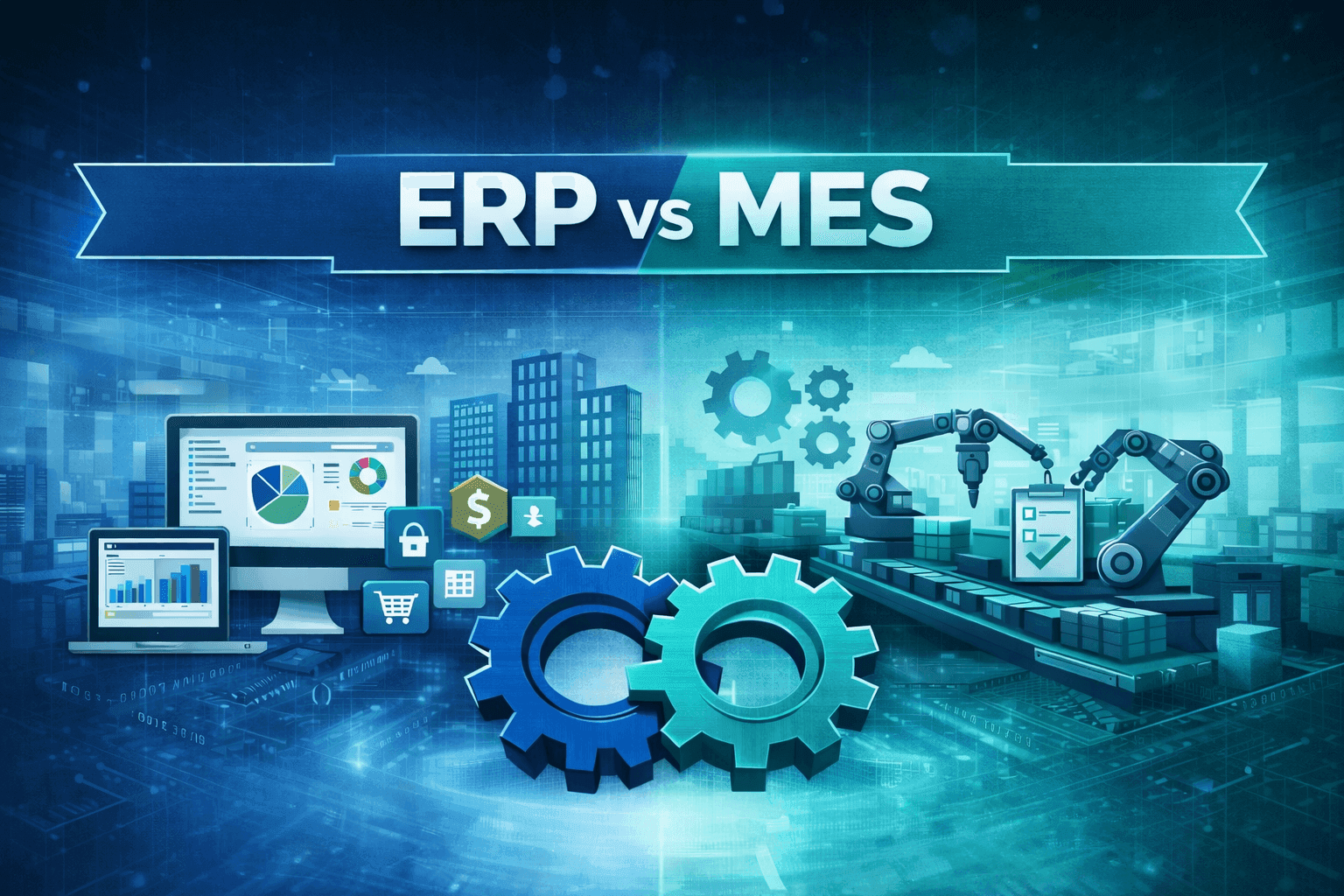


ERP vs MES: Is there a difference? The answer is a resounding YES!
In today’s fast-moving manufacturing world, companies need more than spreadsheets or disconnected software to stay competitive. They need systems that help them plan work, execute work, and understand what’s happening across the entire production process. This needs to happen at both the business level and down on the shop floor.
That’s where ERP (Enterprise Resource Planning) and MES (Manufacturing Execution Systems) come into play. These two systems are often confused, but they serve very different purposes.
If you’ve ever wondered about the difference between MES and ERP, you’re not alone. This is one of the most frequently asked questions manufacturers pose when exploring digital transformation.
This article simplifies both systems, explains their interconnection, and highlights how modern MES platforms guide operators and capture real-time shop-floor data.
ERP vs MES: What Are They?
What is an ERP?
An ERP System (Enterprise Resource Planning) is a software platform that helps companies manage high-level business processes across the entire enterprise. Think of an ERP as the “big picture planner” that connects multiple departments into one centralized system.
ERPs typically handle areas like:
- Financials and accounting
- Procurement and purchasing
- Inventory and supply chain planning
- Human resources
- Sales and customer orders
- High-level production planning
ERP systems are excellent at standardizing data across the company and ensuring everyone from finance to purchasing to operations is working from the same information. They allow organizations to plan resources, forecast needs, and manage business-wide processes.
But here’s the key point:
An ERP does NOT manage real-time production activity on the shop floor.
It plans production at a high level, but it doesn't monitor what’s happening minute-by-minute at each workstation.
This is exactly why MES systems exist.
What is an MES?
An MES (Manufacturing Execution System) is a system designed specifically for managing, monitoring, and controlling what happens on the shop floor in real time. If the ERP is the planner, the MES is the execution engine.
MES systems typically focus on:
- Real-time production tracking
- Operator guidance and work instructions
- Quality checks and shop floor data collection
- Traceability and compliance
- Workflow enforcement
- Performance indicators (cycle time, downtime, scrap, etc.)
In other words, an MES bridges the gap between top-level business planning (the ERP) and the physical production process happening on the factory floor.
MES gives answers to questions like:
- Which operator is working on which job right now?
- How many units were produced today?
- Were there any quality issues?
- What caused downtime?
- Is the process being followed correctly?
MES is all about execution, visibility, and control.
In other words, the ERP sets the plan for the business, while the MES ensures that the plan is executed on the shop floor.
Where VKS Fits In as an MES Solution
VKS is a modern MES platform built around digital work instructions and real-time production intelligence. While many traditional MES systems focus mainly on data collection, VKS also supports operators directly by giving them step-by-step instructions, checklists, and visual guidance.
This combination helps manufacturers reduce errors, improve productivity, and collect detailed, reliable shop floor data. If you want to take a deeper look at how MES systems integrate with the rest of your manufacturing ecosystem, check out our helpful resource on powerful MES Integration solutions.
MES vs ERP: What’s the Difference?
Although MES and ERP systems both support manufacturing organizations, they operate at very different levels.
Here’s a clear and simple breakdown.
| Comparison Point/Category | MES | ERP |
|---|---|---|
| Primary Role | Real-time shop floor execution. | Business planning and coordination. |
| Main Users | Operators, supervisors, quality teams. | Managers, planners, finance, HR, and sales. |
| Key Functions | Work instructions, production tracking, quality checks, and real-time monitoring. | Scheduling, resource planning, inventory control, and purchasing. |
| Output | Actual production results. | Plans and forecasts. |
| Focus level | Tactical and operational; focused on day-to-day, minute-by-minute shop floor activities. | Strategic; focused on long-term business planning, resource allocation, and enterprise-wide coordination. |
| Data Management Capabilities | Collects and analyzes detailed real-time production data directly from operators, machines, and workstations. | Manages high-level, transactional data from across the entire organization. |
| Integrations | Integrates with shop-floor equipment, machines, and production systems. | Integrates with a wide range of business processes and enterprise systems. |
| Connection Between Systems | Sends live production data (progress, quality, and performance) back to ERP. | Sends planned schedules, work orders, BOMs, and demand requirements to MES. |
| Operational Impact | Directly affects manufacturing efficiency, product quality, and compliance on the shop floor. | Improves enterprise-level efficiency, financial accuracy, resource allocation, and customer satisfaction. |
The shortest explanation?
- ERP plans the work.
- MES executes the work.
The most important thing to keep in mind is that MES and ERP solutions are complementary, not competing systems. In the ERP vs MES relationship, ERP handles the planning while MES drives real-time execution. When they work together, manufacturers get accurate data, smoother operations, and better decisions from the top floor to the shop floor.
Why Manufacturers Often Need Both
As manufacturing gets more complicated, using manual methods to connect ERP planning and shop floor work causes problems. Relying on paper instructions, spreadsheets, and separate systems slows down production and makes it harder for people to communicate. These disconnected workflows cause mistakes, delays, and a lack of real-time updates, issues that Manufacturing Execution Systems (MES) are built to fix.
When manufacturers use ERP and MES together, each system supports the other, creating a connected flow of information from planning to production.
1. The ERP Creates the Production Plan
Your ERP is responsible for the “big picture.” It generates:
- Production schedules
- Work orders
- Required materials
- Forecasts based on customer demand
- Inventory and purchasing needs
These planning functions ensure the organization has the right resources ready. But this is where ERP’s job ends because it does not manage what actually happens on the shop floor.
2. The MES Executes the Plan
This is where MES platforms take over:
- Operators receive step-by-step digital work instructions (a core VKS capability).
- Supervisors gain real-time visibility into progress, cycle times, and operator performance.
- Quality checks and validations are enforced directly within the workflow.
- Production data counts, defects, timestamps, traceability is captured automatically
This real-time execution ensures standardization, consistency, and accuracy across every workstation.
3. The MES Sends Real-Time Updates Back to the ERP
When MES systems integrate with ERPs, the information loop is finally complete:
- Completed quantities update automatically
- Scrap or rework is recorded
- Inventory adjusts in real time
- Production status becomes visible to planning and management
- Forecasting and scheduling stay accurate
The MES becomes the source of truth for shop floor execution, feeding ERPs the real-time operational data they cannot capture on their own.
The result? A production environment that is:
- Faster – fewer delays and less manual communication.
- More accurate – real-time data replaces guesswork or outdated spreadsheets.
- More connected – the top floor (ERP) and shop floor (MES) work as one system.
Together, ERP and MES form a closed, end-to-end loop that supports both high-level planning and precise, reliable execution an essential combination for modern manufacturers.
Common Misunderstanding: “I Already Have an ERP. Do I Still Need an MES?”
Many manufacturers assume that an ERP system can handle everything, including shop floor execution. But ERPs are not designed to:
- Give operators step-by-step instructions
- Capture detailed time, quality, and production data
- Track every action with real-time accuracy
- Monitor machines or workstations in the moment
- Provide visual, guided workflows
A good way to look at it is this: Your ERP helps you organize work. Your MES helps you do the work.
ERP without MES Example (Why you don’t want this)
Imagine your ERP creates a production order for 500 units of a product. The plan looks perfect on paper. But on the shop floor, here’s what really happens:
- Operators receive paper instructions The instructions might be outdated, unclear, or missing steps because no system updates them automatically.
- Work happens, but no one sees it in real time The ERP won’t know if operators are ahead, behind, stuck, or blocked by a quality issue until someone manually reports it, often days later.
- Quality checks are easy to miss Without guided workflows, operators rely on memory. A skipped torque check or misassembly goes unnoticed until the final inspection.
- Production data gets recorded at the end of the shift Operators fill out spreadsheets or handwritten logs. By the time this data reaches the ERP, it’s already outdated or sometimes inaccurate.
- A small issue becomes a big problem A single mistake early in the process goes undetected and spreads through the batch, creating rework, scrap, and delays.
The result? Your ERP thinks everything is on schedule. But the shop floor tells a very different story.
Which Comes First: ERP or MES?
ERP comes first, because ERP systems support finance, purchasing, HR, and the supply chain, many companies implement an ERP early in their growth. Since ERP systems form the financial backbone of a company handling accounting, purchasing, and payroll, most manufacturers implement them during their initial scaling phase, often before they consider digitalizing the shop floor with an MES.
MES becomes essential when production complexity increases If you're struggling with:
- Inconsistent processes
- Quality issues
- High training time
- Lack of traceability
- Manual data collection
- Limited shop floor visibility
Then an MES is usually the next logical step.
How MES and ERP Work Together in a Connected Factory
When integrated properly, MES and ERP create a seamless flow of information.
Here’s how the cycle works:
- ERP schedules the job: It determines what needs to be built and when.
- MES receives the job: It assigns work instructions, station routing, and operator tasks.
- Operators execute the work using MES guidance: MES ensures consistency and real-time data capture.
- MES updates progress automatically: Quantities, quality checks, cycle times, and downtime are all recorded.
- ERP receives the data back from MES: This allows planning teams to make accurate decisions.
This closed loop reduces errors, improves forecasting, and ensures that both office-level and shop-floor teams are aligned.
How a Worker-Centric MES Enhances MES Capabilities
Traditional MES systems collect data, but they don’t always help operators do the work correctly. A worker-centric MES improves this by focusing on the people on the shop floor. By guiding operators and capturing data at the same time, your MES capabilities become stronger, more accurate, and easier to use.
How a worker-centric MES strengthens shop floor functionality:
- Clear digital work instructions: Operators receive visual, step-by-step instructions with photos, videos, and notes. This makes complex tasks simple and ensures everyone follows the same process.
- Real-time production tracking: As operators move through the steps, our worker-centric solution automatically tracks progress, cycle times, and workstation activity, giving supervisors live visibility.
- Automatic data collection: No more writing things down. VKS captures counts, measurements, and quality checks automatically as part of the workflow, reducing mistakes and improving traceability.
- Built-in quality checks: Important confirmations, like measurements, part verification, or inspections are built directly into the instructions. Operators can’t move forward until each check is done correctly.
- Scales easily: Whether you have a small team or a large multi-site operation, VKS scales without adding complexity, keeping every workstation aligned and consistent.
Why does this matter?
Instead of just reporting what happened on the shop floor, a worker-centric MES like VKS ensures the work is done right the first time. By guiding operators and collecting real-time data at the same time, it becomes an MES that not only monitors production, but also actively improves it.
The Competitive Advantage of Integrated Systems
Understanding the difference between ERP vs MES is key for any manufacturer looking to improve efficiency. ERP handles the big-picture planning of what needs to be made, when, and with which resources, while MES makes sure that the plan actually happens on the shop floor in real time. When the two systems work together, companies get accurate data, smoother production, and better decision-making from start to finish.
Modern, worker-centric MES platforms like VKS take this even further by guiding operators step-by-step and collecting real-time data automatically. This creates a connected factory where planning and execution stay perfectly aligned. In today’s fast-paced manufacturing world, using both ERP and MES isn’t just helpful; it’s becoming essential for staying competitive.