


Manufacturers today need speed, flexibility, and real-time decision-making. However, many are still relying on traditional MES strategies that were designed for a slower, more predictable industrial environment.
In 2026, this gap is becoming a serious problem.
This article explores why traditional MES approaches are falling behind, what modern alternatives like composable MES platforms look like, and how manufacturers can move forward without replacing everything at once.
The Problem with Traditional MES Strategies
For years, Manufacturing Execution Systems (MES) have been positioned as the backbone of shop floor operations. They help track production, manage work orders, and provide visibility into manufacturing processes.
Recent research highlights why.
According to McKinsey, legacy systems remain deeply embedded across industries, often acting as a massive anchor slowing a business down, with many systems built decades ago and difficult to modernize or replace. These systems create technical debt, limit agility, and make it harder for manufacturers to adapt to changing production needs.
The result is a rigid system that works, but cannot easily adapt.
This lack of flexibility makes it difficult for manufacturers to respond quickly to:
- changing production demands
- workforce variability
- supply chain disruptions In practice, traditional MES strategies often create rigidity at the exact moment manufacturers need agility.
Why an 18-Month MES Implementation Is a Death Sentence in 2026
In today’s environment, waiting 12–18 months to implement an MES is not just inefficient, it’s also risky.
Here are 3 reasons why:
1. You Lose Competitive Agility Markets shift quickly. Customer demands change. Supply chains fluctuate. If your MES takes over a year to deploy, your processes are already outdated by the time the system goes live.
2. High Risk of Project Failure Long MES implementations often involve:
- Scope creep: Requirements expand as stakeholders pile on new demands mid-project, stretching timelines and diluting the original goals.
- Budget overruns: Extended projects consistently consume more resources than planned, often exceeding initial budgets.
- Misalignment between IT and operations: When implementation drags on, teams lose confidence, often leading to poor adoption and workarounds that undermine the entire investment. Research from McKinsey shows that large digital transformation projects often fail to meet expectations due to complexity and unclear ROI.
3. Delayed ROI The longer it takes to implement, the longer it takes to see value.
Manufacturers invest in MES to improve productivity, quality, and visibility, but those benefits are postponed when deployment takes over a year.
Instead of accelerating performance, the system becomes a blockage.
Option 1: The Composable MES: Build On Top Of What You Have
To address these challenges, manufacturers are moving toward more flexible approaches, often referred to as composable MES.
Composable architecture is based on the idea of building systems from modular, reusable components that can be quickly assembled and reconfigured as business needs change. This approach allows manufacturers to avoid the rigidity of legacy MES platforms and instead create more agile, scalable systems.
In manufacturing, this translates into:
- Deploying smaller, focused applications instead of large monolithic MES systems.
- Integrating best-in-class tools (ex. work instruction software, quality tools, analytics platforms).
- Iterating quickly and progressively instead of waiting for full system rollouts. This shift is especially important in 2026, where production environments are constantly evolving due to supply chain disruptions, workforce changes, and increasing customization demands.
For example, solutions like digital work instructions allow manufacturers to quickly digitize workflows, provide real-time guidance, collect execution data, and connect to IoT devices/machines.
This kind of modular approach supports a more iterative MES deployment strategy, enabling faster ROI and reducing implementation risk.
How Do I Fix My Rigid MES?
If you already have a traditional MES in place, replacing it entirely may not be the best first step.
Digital transformation in manufacturing delivers more value when approached incrementally, focusing on targeted improvements rather than full system overhauls.
Organizations like McKinsey highlight that legacy technology continues to act as a major constraint for organizations, with many systems decades old and difficult to replace right away.
Companies are increasingly focused on progressively modernizing their systems through an iterative process to unlock value faster.
You can learn more about how this works here: Top 15 Standard Work Instruction Examples
According to McKinsey, organizations are turning to composable technology architectures, which allow new tools to be layered on top of existing systems rather than replacing them all at once. This approach enables faster innovation, easier integration, and reduced risk by keeping core systems in place while extending the capabilities of your operation.
This shift is also reflected in the MES market itself. MES solutions are evolving toward composable and integrated platforms, where functionality is distributed across connected systems instead of a single monolithic application.
In practical terms, this method focuses on improving how your MES is fueled, not replacing it.
By introducing systems that capture execution data, such as digital work instruction platforms, manufacturers can enhance visibility, traceability, and performance without disrupting operations.
Instead of a full overhaul, all at once, this approach strengthens your existing MES by feeding it higher-quality, contextual data. The result is a more flexible, scalable system that aligns with modern MES strategies and supports continuous improvement without the cost and risk of starting over.
The Missing Piece: Execution-Level Data
Most traditional MES systems are strong at tracking high-level operational metrics. However, it often falls short when it comes to explaining how the work is actually being performed. That gap is critical.
For example, a traditional MES platform won’t show whether an operator followed the correct procedure, if a step was skipped, or if a deviation occurred during execution.
This is where digital work instruction platforms like VKS play a key role.
These systems operate directly at the point of work, guiding operators through standardized processes while simultaneously capturing real-time execution data. Instead of relying on manual reporting or assumptions, manufacturers gain a clear, traceable view of how each task is completed.
With a platform like VKS, manufacturers can capture:
- Step-by-step task execution and progression
- Operator inputs and confirmations
- Precise timestamps for each action
- In-process quality checks and validation points
- Deviations, rework, and exception handling
This level of detail connects performance outcomes directly to execution behavior, enabling faster root-cause identification, standardization of best practices, and continuous process improvement.
Why a New MES Strategy Makes a Difference
When your MES is supported by detailed execution data, it becomes far more valuable.
You gain better visibility into the process, making it easier to identify root causes of defects or delays. KPIs like First Pass Yield and Cycle Time become more accurate because they are based on real execution, not estimates or delayed entries.
Instead of replacing your MES, you are strengthening it.
This is a key principle behind modern MES strategies, extending existing systems with better data rather than rebuilding everything from scratch.
When your MES is enriched with structured execution data:
- KPIs become more accurate
- Root cause analysis becomes easier
- Continuous improvement becomes actionable Instead of a complete overhaul, you extend the value that’s already there.
Option 2: Iterative MES Deployment: A Smarter Approach
One of the biggest shifts in recent years is the move toward iterative MES deployment.
Rather than launching a full system all at once, manufacturers are breaking deployments into smaller, manageable steps. Each step delivers value quickly and builds momentum for the next.
This approach reduces risk, improves adoption, and allows teams to adjust based on real-world feedback.
Digital work instructions are often one of the first and most effective areas to start because they directly impact how work is performed and how data is captured.
How to Deploy an MES Module in 1 Week
While a traditional MES rollout can take months (or years), certain components can be deployed much faster.
One example is an agile human-centric MES that leverages digital work instructions to iteratively strengthen the worker and the operation in manageable phases.
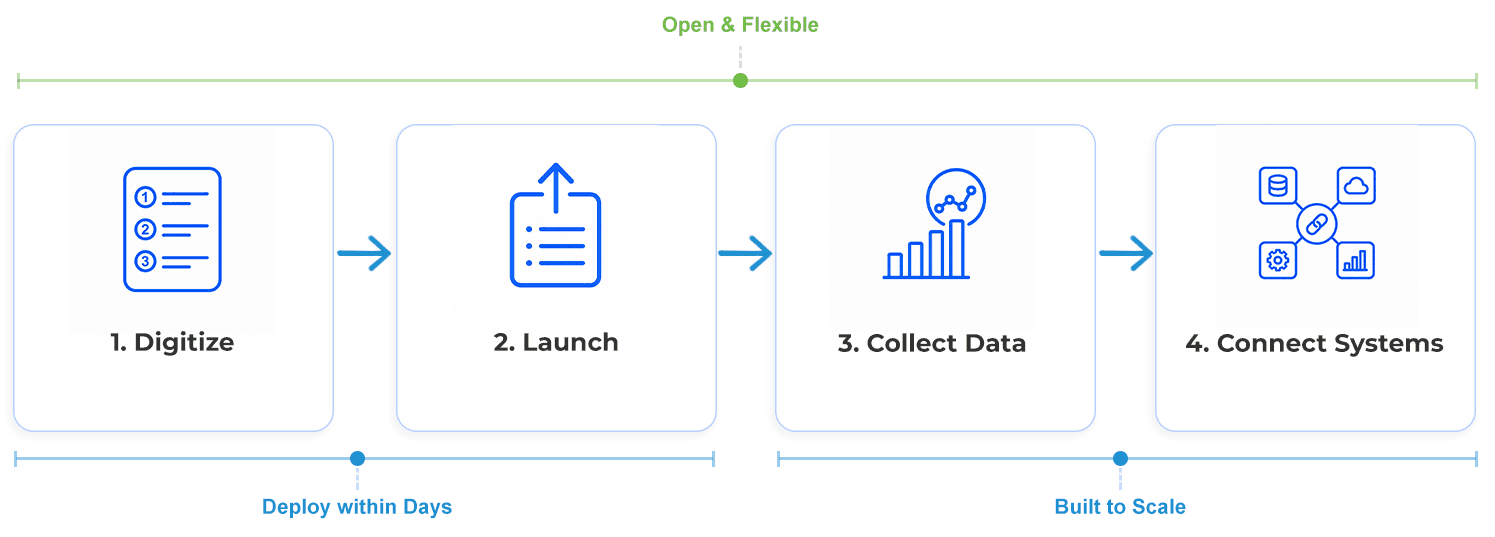
Phase 1. Digitize Work Instructions
Convert paper-based or static procedures into interactive digital guides, which are step-by-step guides used directly on the shop floor. Unlike static PDFs or paper binders, these instructions can include images, videos, annotations, and smart forms to guide operators through each task with clarity and consistency.
By digitizing your processes, you eliminate outdated documents and ensure every operator follows the same, most up-to-date method.
Immediate benefit: You gain instant process standardization and reduce errors caused by unclear or outdated instructions.
Phase 2. Launch on the Shop Floor
Once instructions are created, they can be deployed immediately for operators to use.
Operators benefit from: -Visual instructions -Real-time guidance -Built-in quality checks Because the system is intuitive, training time is minimal and adoption can happen quickly, even across multiple shifts.
Immediate benefit: You improve operator performance and reduce training time from day one.
Phase 3. Start Capturing Data
From day one, the system collects:
- Competed quantities
- Production times
- Quality results
- Efficiency rates
- Worker performance
- Productivity trends
- SPC data
- Serial/part numbers
- Digital signatures
- Operator feedback
- And much more! Because this data is captured during execution and not after the fact, it is far more accurate and actionable.
Immediate benefit: You gain real-time visibility into operations without relying on manual data entry or delayed reporting.
Phase 4. Connect to Existing Systems
This data can then feed into your:
- ERP
- BI Software
- CMMS
- QMS
- LMS
- And more!
This phased process is what makes iterative MES deployment so powerful. You start small, deliver value quickly, and expand based on results.
You can learn more about how this works here: The API Capabilities of Work Instruction Software
Immediate benefit: You break down data silos and enable smarter, cross-functional decision-making.
Why This Works
MES platforms like VKS are designed for rapid deployment and ease of use. This allows manufacturers to:
- Improve work order control
- Standardize processes
- Capture valuable execution data All this without waiting months or years for a full MES implementation.
An additional advantage comes from integrating connected devices and shop floor equipment. With solutions like VKS EDGE, manufacturers can connect tools, sensors, and machines directly to their workflows, enabling automated data capture such as torque values, cycle counts, and process validation.
This creates a more complete and accurate picture of operations by combining human actions with machine/device data.
Traditional MES vs Modern MES Strategies
The difference between traditional and modern approaches is not just technical. It’s strategic.
- Traditional MES focuses on control and centralization, often at the cost of flexibility.
- Modern MES strategies prioritize adaptability, speed, and integration.
Instead of waiting for a full system to deliver value, manufacturers can now build capabilities step by step, using tools that complement and enhance existing systems.
| Traditional MES | Modern MES Strategy |
|---|---|
| Rigid architecture. | Flexible, composable systems. |
| Limited execution visibility. | Rich, contextual shop floor data. |
| High-risk projects. | Iterative, low-risk rollout. |
| Delayed ROI. | Faster time-to-value. |
What This Means for Manufacturers in 2026
Manufacturing is becoming more connected, more data-driven, and more responsive. To keep up, systems need to evolve as quickly as operations do.
Traditional MES systems still have a role to play, but they are no longer enough on their own.
Manufacturers that succeed in 2026 will be the ones that:
- Adopt flexible, composable MES strategies.
- Focus on capturing high-quality execution data.
- Deploy solutions iteratively instead of all at once.
Read Next: Is MES Integration Important?