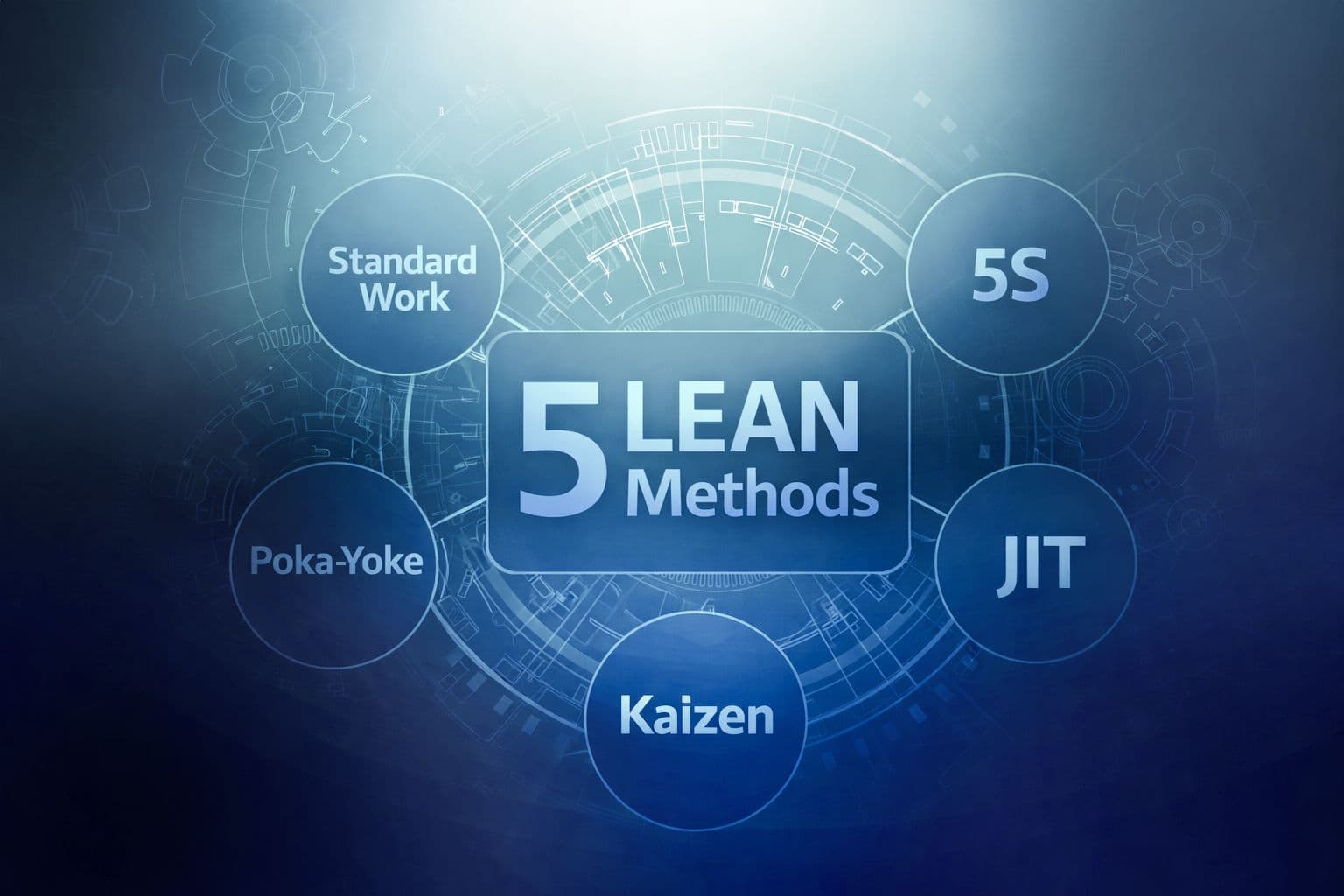


Lean Production Methods are more than a set of tools. It is a culture of ongoing improvement. It focuses on empowering workers, improving flow and reducing waste.
The concepts of lean have grown more crucial than ever. Companies deal with more complicated product variations, tighter labor markets, and increased quality standards.
However, Lean Production Methods now have a different appearance. Modern operations combine traditional methods with digital platforms, smart gadgets, and automated quality systems. For this article, we'll see how a lean mindset and advanced manufacturing solutions increase output.
They also improve quality and give manufacturers real-time knowledge to succeed.
Here are five of the best Lean Production Methods. You will also see how MES and digital work instructions use them on the shop floor.
Lean Method 1: Standardized Work: The Backbone of Quality and Consistency
Lean Production Methods are based on standardized work. It is practically impossible to assess performance, find waste, or make changes without routine processes.
Why Standardized Work Is a Game-Changer
By ensuring that every operator follows the most effective method, standardized work reduces variance that can result in errors. Additionally, it strengthens responsibility and traceability throughout the process, making operations quicker, safer, and more effective. Above all, it acts as the starting point for continuous improvement.
Clear, consistent instructions are the first step in the lean methodology.
Digital Work Instructions Improve Standardized Work
Organizations can provide visual, detailed work instructions that are:
- Version-controlled
- Easy to update
- Accessible on any device
- Supported with photos, videos, and annotations
- Linked to tools, parts, and quality checks
When using digital work instructions, operators get clear, precise steps. They do not need paper binders or tribal knowledge.
Moreover, the optimal procedure quickly becomes the norm across all shifts and lines thanks to timely updates.
Lean Method 2: 5S: Establishing a Seamless, Hassle-Free Work Environment
The 5S approach; Sort, Set in Order, Shine, Standardize, and Sustain establishes an orderly, structured environment that promotes productivity and safety.
The Reasons 5S Is Effective
Time spent looking for tools, waiting for missing supplies, or fixing avoidable mistakes are decreased in a neat and organized setting. It increases security and fosters a disciplined and involved culture.
5S's Effect on Your Shop Floor
- Faster changeovers
- Lower risk of injury
- Better visual management
- Greater accountability
- Higher operator morale
Production runs better when everything is in its proper location!
How Digital Work Instructions Assist with 5S Projects
Digital Work Instructions include key items to help operators follow 5s every time.
These items include:
- Tool diagrams
- Worspace layout plans
- Clearly defined cleaning tasks
- Essential safety reminders
- Daily or shift-based checklists
- And more
Together, these components create a structured, organized, and safe environment. These also reinforce good habits and supports long-term operational excellence.
With digital work instructions, 5S integrates directly into the process rather than being a one-time undertaking. To maintain gains over time, teams can even record audit findings or take before-and-after pictures.
Lean Method 3: Poka-Yoke: Preventing Errors to Ensure Quality from the Start
One of the main principles of Lean Production Methods is error-proofing, also known as poka-yoke. This method guarantees that operations can avoid or detect errors right away. This detection most often occurs before they have an adverse effect on the customer, safety, or quality.
Poka-Yoke Examples
- Fixtures that prevent misalignment
- Sensors verifying component presence
- Step confirmations preventing skipped tasks
- Color-coded components and tooling
- Checklists tied to real-time validation
However, modern error-proofing extends beyond tangible fixtures.
Smart Error-Proofing with Connected Devices
The best manufacturing solutions allow strong automated checks by connecting the worker with their shop floor devices, such as:
IoT Torque Tools: The work instruction platform connects to IoT torque tools. It sets torque values automatically. It checks correct fastening and guides error-proof assembly steps. It also records toque data in real time for full quality traceability.
Pick-to-light: The work instruction platform links to PTL sensors and lights. It guides users and ensures they pick up the right component.
Label Printer: To ensure single-point data entry and remove inconsistencies between digital records and physical labels, the work instruction platform connects with label printing software to print labels straight from digital forms.
Test Bench: The work instruction platform maintains 100% traceability by integrating with test bench hardware to begin tests, evaluate findings, and apply pass/fail criteria.
Vision System: To automate inspections, verify assembly validity, and standardize quality checks across operations, the work instruction platform connects with AI-powered vision systems.
PLC / IoT Sensors: The work instruction platform links digital instructions to real-time machine and process data. It does this by integrating with PLCs and Internet of Things sensors on the shop floor.
Machines: The work instruction platform keeps operations in sync and boosts efficiency. It collects accurate data by integrating automated and manual machines into one workflow.
As a result, a closed-loop process is produced that significantly lowers faults and boosts operator trust.
Lean Method 4: Just-in-Time (JIT): Producing with Exact Precision
One of the most prevalent Lean Production Methods, Just-in-Time, lowers waste by closely matching output to demand. Manufacturers don't push inventories; instead, they just create what is required, at precisely the right time. Instead of pushing inventory, manufacturers use a 'pull' system. The produce only what is needed, right when it is required.
Just-in-Time Advantages
- Decreased surplus inventories and overproduction
- Quicker reaction to consumer demand
- Reduced lead times
- Lower carrying costs
- Increased bottleneck visibility
Drawbacks of JIT
Precise workflow visibility, dependable processes, and exact timing are necessary for JIT. Production can be disrupted by any deviation, including missing materials, machine downtime, and quality problems.
How JIT Systems Are Improving Modern Manufacturing Solutions
By offering real-time cycle time tracking and automatic updates, modern MES platforms facilitate Just-in-Time (JIT) manufacturing. This guarantees that each stage of the process remains on schedule. When devices, including PLCs, sensors, and machines, are connected, timing is consistent. Plus, operators are guided step-by-step through their jobs by digital pick lists.
Additionally, alerts help ensure a timely, effective, and seamless production flow by alerting teams anytime takt time deviates from the range. Digital traceability and automatic error-proofing make JIT simpler to maintain consistently, cutting waste without sacrificing production rate due to unforeseen fluctuations.
Lean Method 5: Kaizen: A Culture of Continuous Improvement
Another crucial component of Lean Production Methods is kaizen, or continuous improvement. It motivates teams to find minor adjustments that add up to significant performance improvements.
By enhancing team communication and empowering operators, kaizen adds substantial value. It ensures that continuous improvement is ingrained across the company by lowering process variance, promoting proactive problem-solving, and cultivating an innovative culture. Shop floor operators become process improvers instead of process followers thanks to kaizen.
How Ongoing Kaizen Is Made Possible with Modern MES Solutions
Powerful digital solutions like work instruction software and/or empower operators to generate continual, quantifiable, and actionable improvements by:
- Capturing process issues directly from the standardized process.
- Data capture improvement opportunities for enhanced accuracy and traceability.
- Monitor and validate any variations from specifications or risks to quality.
- Users can submit photos and NCRs (Non-Conformance Reports & Resolutions) directly within the platform.
- Streamline communication by automatically sending updates to supervisors.
Using modern manufacturing software, businesses can track trends in cycle time variation, rework, non-conformance reports, and more using built-in analytics, which helps determine where lean changes will have the most effect.
Read More: Is MES Integration Important?
Bringing It All Together: Bridging Lean Production Methods and Digital Manufacturing
When combined with digital tools, Lean Production Methods become observable, reproducible, and actionable. They simply flourish. By combining people, procedures, and technology into a single, integrated platform, VKS closes a gap. This ga has become all too common in the manufacturing industry.
Manufacturers use VKS and Lean Production Methods to:
- Standardize and digitize best practices
- Combine work instructions with PLCs, robots/cobots, sensors, vision systems, and tools
- Automate validation and quality checks
- Cut down on training time and improve workforce preparedness
- Capture real-time production data for continuous improvement
Lean manufacturing is a dynamic system rather than a one-time project. Additionally, your shop floor becomes more robust, adaptable, and able to maintain long-term operational excellence. And this is because you're powering lean with the proper digital infrastructure.
Where VKS Comes Into Play
With robust, user-friendly digital tools made for real-world manufacturing, VKS assists transforming your processes into visual, easy-to-follow, digitally standardized guides. Whether you're just starting or want to update existing systems, VKS offers the resources required to:
- Standardize best practices
- Digitize and visualize complex processes
- Integrate work instructions with sensors, machines, and tools
- Automate validation and quality checks
- Capture production data for ongoing improvement
VKS assists in converting Lean Production Methods into scalable, data-driven procedures that promote long-term operational excellence, regardless of whether you're starting your lean journey or refining an existing system.