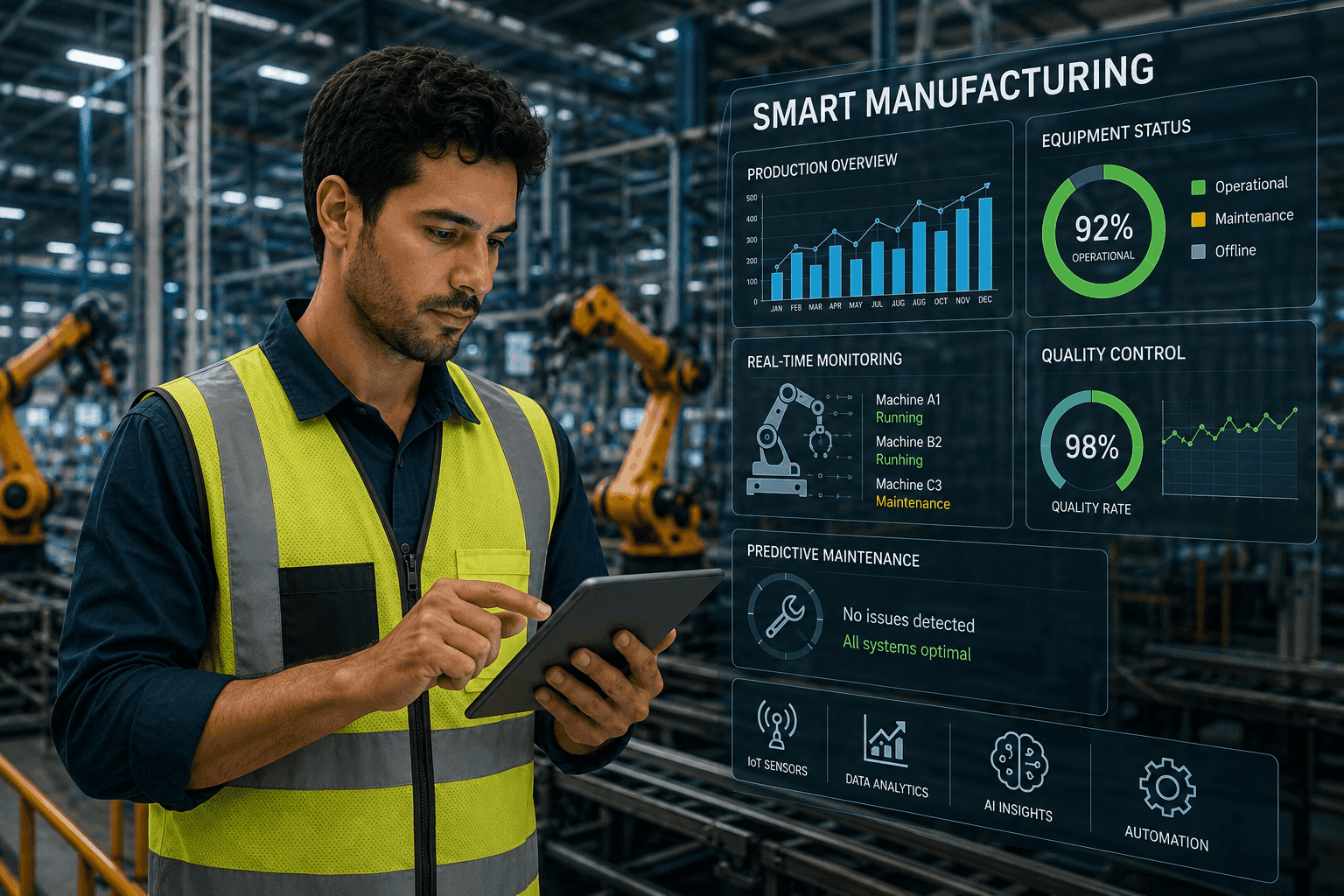


Today’s manufacturers are facing mounting pressure from every direction. Supply chain disruptions, labor shortages, shifting customer expectations, and increasingly complex production requirements are making it harder to maintain efficiency, quality, and profitability. At the same time, companies are expected to produce faster, adapt more quickly, and maintain greater visibility across their operations, all while minimizing downtime and reducing costs.
To overcome these challenges, many manufacturers are turning to smart manufacturing technologies. By leveraging connected systems, real-time data, and digital tools, businesses are creating more agile, efficient, and responsive operations. These technologies provide greater visibility into production processes, improve decision-making, and help manufacturers better adapt to changing demands in an increasingly competitive industry.
Let’s take a look at five smart manufacturing examples that demonstrate how modern technology goes beyond simple automation. We'll observe how smart manufacturing fosters employee empowerment, strengthens teamwork, and promotes continuous improvement across your operations.
Smart Manufacturing Example 1: Digital Work Instructions That Standardize Operations
The use of digital work instructions is among the most significant instances of smart manufacturing because it solves an issue that still affects manufacturers today: Paper work instructions.
Traditional, paper-based instructions frequently result in inconsistent practices, outdated procedures, and communication issues between facilities and/or jobs.
Digital work instructions make it easier for operators to acquire and follow crucial information while also assisting manufacturers in standardizing operations.
Why Digital Standardization Matters
When operators adhere to precise and consistent guidelines, manufacturers can:
- Reduce process variation.
- Improve product quality.
- Accelerate employee training.
- Increase traceability.
- Minimize production errors.
Operational excellence and continuous improvement are made possible by standardized processes and procedures.
How Smart Manufacturing Enhances Work Instructions
With modern work instruction platforms, companies can develop interactive, visual processes that are:
- Version-controlled.
- Easy to update in real time.
- Accessible from any device.
- Supported with images, videos, and annotations.
- Linked to tools, machines, and quality checkpoints.
- Able to overcome any language barrier with the use of AI.
Operators receive accurate instructions at their workstation rather than depending on outdated binders or tribal knowledge. This makes it simpler to scale best practices across facilities, manufacturing lines, and international operations.
Smart Manufacturing Use Case 1: Standardizing Assembly Processes
Clark works as an electronics assembly operator in a high-mix production line that moves quickly. Operators frequently relied on dated paper binders, handwritten notes, and verbal direction from experienced workers.
Process variation became a recurrent problem since multiple shifts had varied interpretations of the procedures. Operators regularly halted production to verify assembly steps, quality problems rose, and it took longer to educate new hires.
However, recently, Clark’s company implemented their first smart manufacturing technology: digital work instructions.
Now, he has visible, step-by-step instructions at his workplace. Operators are empowered to follow the same standardized process with instructions that are clear, concise, and visual. Consequently, onboarding happens more quickly, process consistency increases, and operators can finish assemblies accurately and confidently.
Smart Manufacturing Example 2: Connected Workers That Improve Communication
Communication breakdowns between departments, operators, and supervisors cause production to lag and errors to rise. By offering workers access to real-time information and collaboration tools, smart manufacturing systems assist in closing these gaps.
The Advantages of a Connected Workforce
Companies and their workers can use connected worker technologies to:
- Access production information instantly.
- Report issues in real time.
- Communicate directly with supervisors.
- Receive live process updates.
- Collaborate across departments more effectively.
As a result, decisions are made more quickly, accountability is improved, and teamwork is reinforced across the board.
How the Shop Floor Is Supported by Connected Worker Platforms
Digital workstations, wearable technology, tablets, and mobile devices are all immediately integrated into production processes to support workers on the shop floor:
- Operators can take pictures, record problems, send non-conformance reports, and access troubleshooting guidebooks.
- Supervisors have instant access to reports and production issues, which enables teams to react more quickly and minimize downtime.
Connected Worker Technology enables manufacturers to establish a more responsive and agile operation by enhancing communication throughout the shop floor.
Smart Manufacturing Use Case 2: Improving Communication With Connected Workers
Now that standardization is in place, Clark’s company can ramp up production and build more complicated assemblies.
Clark discovers that a component is not aligned correctly during his assembly.
In the past, he would have had to halt production, look for documentation, or wait for a supervisor to manually look into the problem. Delays in communication frequently led to extra quality risks and needless downtime.
But now, Clark has instant access to troubleshooting information on a tablet. Without leaving the manufacturing floor, he takes a picture of the problem, files a digital non-conformance report, sets the unit aside, notifies his supervisor, and continues working.
Before more goods are assembled incorrectly, the supervisor promptly determines that an incorrect component batch was supplied to the line and isolates the impacted inventory. To ensure that all operators receive the updated instructions, engineering teams update the digital processes.
Connected worker solutions enable Clark’s team to respond to problems quickly by enhancing communication between operators, supervisors, and engineering teams. This then greatly reduces downtime and production disruptions.
Smart Manufacturing Example 3: Smart Tool Integrations That Improve Quality
The next effective form of smart manufacturing is the direct integration of machines, tools, and sensors into your digital workflow.
Manual inspections and paper-based tracking are common components of traditional quality checks. But they are also prone to human error.
With connected devices, smart manufacturing systems enhance traceability and automated validation processes.
Examples of Smart Manufacturing Integrations
Modern smart manufacturing platforms provide direct access to:
- IoT torque tools
- Pick-to-light systems
- PLCs and IoT sensors
- Vision systems
- Test benches
- Label printers
- Automated machinery and cobots
- And much more
Manufacturers can eliminate operator errors, automatically validate assembly processes, and record production data in real time by integrating these physical tools with their smart manufacturing platforms.
Why Connected Devices Matter
Connected systems improve manufacturing operations by:
- Preventing incorrect assembly steps.
- Verifying measurements automatically.
- Improving product traceability.
- Reducing rework and scrap.
- Increasing operator confidence.
Manufacturers develop a closed-loop system in which quality checks take place at every stage of production rather than depending on manual inspections.
Consequently, quality is no longer reactive but rather proactive.
Smart Manufacturing Use Case 3: Using Smart Tool Integrations to Improve Quality
To keep up with production and maintain quality, Clark’s company recently installed new IoT tools to further augment their digital workflows. Now, Clark uses smart torque tools that are directly integrated into his digital work instructions.
Every time Clark fastens a bolt, the smart manufacturing platform performs the following actions behind the scenes:
- Applies the right torque automatically.
- Validates torque parameters.
- Auto-advances through steps.
- Detects errors in real time.
- Collects and stores torque data.
If a bolt or screw is fastened improperly, the connected worker platform instantly notifies the operator.
Quality teams also receive total visibility into each completed assembly, thanks to the automatic recording of production data for traceability.
This integration eliminates rework, stops defects from spreading downstream, and boosts confidence in the quality of the finished product.
Smart Manufacturing Example 4: Real-Time Production Visibility
The absence of real-time operational visibility is one of the main issues in traditional manufacturing environments. Reduced efficiency, hidden bottlenecks, and slower decision-making are frequently the results of delayed information.
In order to overcome this difficulty, smart manufacturing technologies link production data directly to the physical and digital systems on the shop floor. This provides decision makers with the knowledge they need for success.
The Importance of Real-Time Data
Real-time visibility helps manufacturers:
- Monitor production performance instantly.
- Detects bottlenecks faster.
- Track downtime and cycle times.
- Improve scheduling decisions.
- Respond quickly to production issues.
Teams can resolve issues before they become expensive diversions when they have instant access to operational data.
How MES Platforms Improve Visibility
Dashboards that show real-time production metrics, quality alerts, machine status, and process performance are accessible to operators, supervisors, engineers, and management teams. This facilitates faster and evidence- based decision-making and enhances departmental alignment.
Manufacturers can optimize operations effectively using true data sources rather than responding to incomplete data that may already be days old.
Smart Manufacturing Use Case 4: Improving Real-Time Production Visibility
As a manufacturing supervisor, Lois is in charge of several assembly lines. Her team mostly uses spreadsheets, manual updates, and end-of-shift reports to monitor production performance.
Production bottlenecks frequently remained unreported due to a delayed flow of information. Supervisors found it difficult to pinpoint the underlying reasons for persistent slowdowns. Schedule changes were reactive rather than proactive, and downtime occurrences were sometimes discovered too late.
To solve this, Lois and her team implemented a human-centric MES that integrates with their ERP and other systems and tools. By linking their smart manufacturing technologies, Lois is instantly updated with production updates, cycle times, downtime events, and quality alerts.
On one shift, Lois observes that cycle times on one assembly line abruptly start rising above allowable limits.
Rather than finding the problem later in a production report, she investigates further and finds a material flow issue that is causing operators to slow down. By fixing the problem before it causes more significant production delays, the facility is able to maintain output goals and cut down on needless downtime.
Real-time manufacturing systems enable supervisors to make quicker, better-informed decisions throughout the day by enhancing operational visibility.
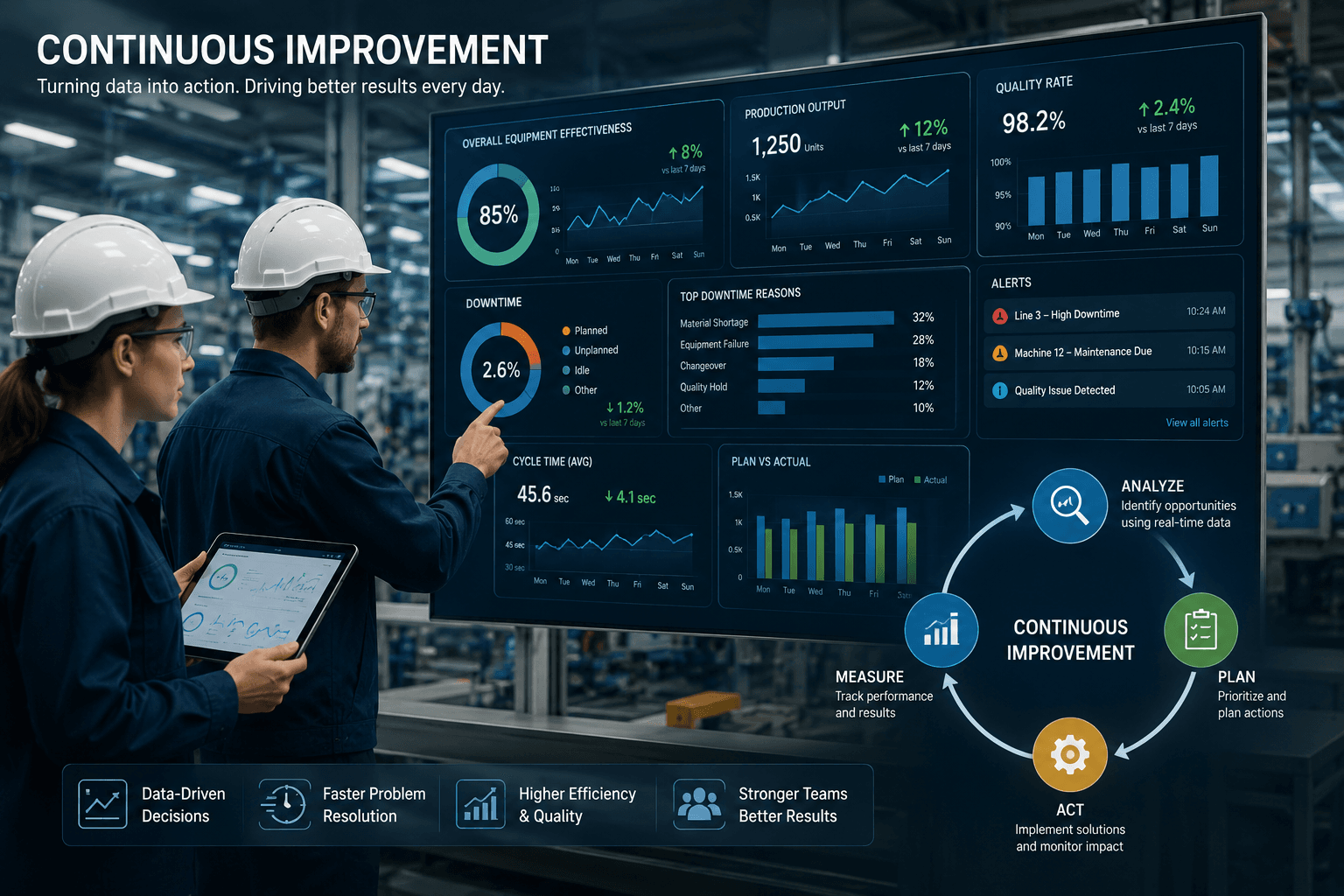
Smart Manufacturing Example 5: Continuous Improvement Powered by Data
The evolution of any manufacturing environment traditionally relies on continuous improvement. However, continuous improvement can be a very slow process if the right tools are not used.
Smart manufacturing enables businesses to tackle improvement projects much more quickly, accurately, and transparently. This is because modern manufacturing systems generate new chances for process optimization by continuously gathering operational data straight from the shop floor.
Why Data-Driven Improvement Matters
Smart manufacturing enables businesses to:
- Identify recurring production issues.
- Monitor process variation.
- Analyze downtime trends.
- Track quality performance.
- Measure workflow efficiency.
As a result, continuous improvement becomes an effective part of the operational strategy rather than a one-time effort.
How Smart Manufacturing Supports Continuous Improvement
Teams can obtain production data directly from machines and operators with the use of digital manufacturing systems.
Manufacturers can:
- Record process deviations in real time.
- Submit non-conformance reports digitally.
- Track recurring quality issues.
- Analyze production trends using built-in analytics.
- Monitor improvement initiatives over time.
Teams are better able to determine where improvements will have the most effect because data is collected automatically. This leads to more resilient operations, stronger quality systems, and smarter workflows.
Smart Manufacturing Use Case 5: Supporting Continuous Improvement With Data
Continuous improvement is most effective when manufacturers can identify issues, validate solutions, and measure results using real operational data.
In our example facility, Clark's daily work on the production line generates valuable insights that help drive ongoing improvements.
1. Digital Work Instructions record Clark's task completion times and flag deviations from standard procedures. Over time, the data reveals that one assembly step consistently takes longer than expected.
2. Connected Worker Technology captures non-conformance reports submitted by Clark and other operators. The reports reveal a recurring alignment issue that contributes to delays and quality concerns.
3. Smart Tool Integrations automatically verify critical process parameters after engineering implements a corrective action. This ensures the new process is being followed correctly and produces consistent results.
4. Real-Time Visibility allows Lois to monitor performance through live dashboards. She can track cycle times, quality metrics, and process adherence to confirm that the improvement initiative is reducing variation and improving outcomes.
Together, these smart manufacturing solutions create a continuous improvement loop. Clark's daily work generates the data, Lois monitors performance, and engineering acts on emerging patterns. Rather than relying on assumptions or periodic reviews, the organization can continuously identify opportunities, implement improvements, and measure their impact using real-time operational insights.
Bringing It All Together: Smart Manufacturing Is About People, Processes, and Technology
Adding more technology to the shop floor isn't the end goal of smart production. Instead, the focus should be on developing interconnected and flexible environments where humans and technology work in harmony.
Through the integration of digital work instructions, MES software, smart tool integrations, connected worker platforms, and real-time analytics, manufacturers can:
- Standardize best practices.
- Improve workforce readiness.
- Increase operational visibility.
- Reduce errors and downtime.
- Strengthen quality control.
- Support continuous improvement initiatives.
Smart manufacturing is about an ever-evolving approach aimed at creating operations that are more resilient, data-driven, and agile.
Where VKS Comes Into Play
Through effective digital work instructions, connected worker solutions, human-centric MES, and connected tools/devices, VKS drives continuous improvement forward. This smart manufacturing technology assists manufacturing facilities in bridging the gap between workers, processes, and technology.
With VKS, manufacturers can:
- Standardize and digitize complex processes.
- Create visual and interactive work instructions.
- Integrate tools, sensors, PLCs.
- Automate quality validation and traceability.
- Capture real-time production data.
- Support continuous improvement initiatives across operations.
VKS gives manufacturers the resources they need to build smarter, more connected shop floors that are designed for long-term operational success, whether they are starting their smart manufacturing journey or updating their current systems!