

The Manufacturing KPIs That Actually Matter in 2026 (And Why Your Software Determines What You Can Measure)
In today’s fast-paced manufacturing world, having the right data is more crucial than ever. Key Performance Indicators (KPIs) are essential tools that help manufacturing leaders track productivity, quality, efficiency, and profitability. While many manufacturers monitor numerous metrics, only a select few actually lead to significant improvements in operations. What makes the difference? It’s not just about which KPIs you choose to follow; it’s about having the right manufacturing software to gather accurate data right at the source. This software should offer more than just pretty graphs and dashboards. It needs to organize workflows, collect detailed execution data, and provide reliable insights that can be used alongside Business Intelligence tools like Microsoft Power BI, Tableau, or Looker. In this article, we will explore the most important manufacturing KPIs that companies should prioritize in 2026 We’ll also discuss how the right software plays a critical role in what you can measure and improve within your operations.
Top 9 Manufacturing KPIs
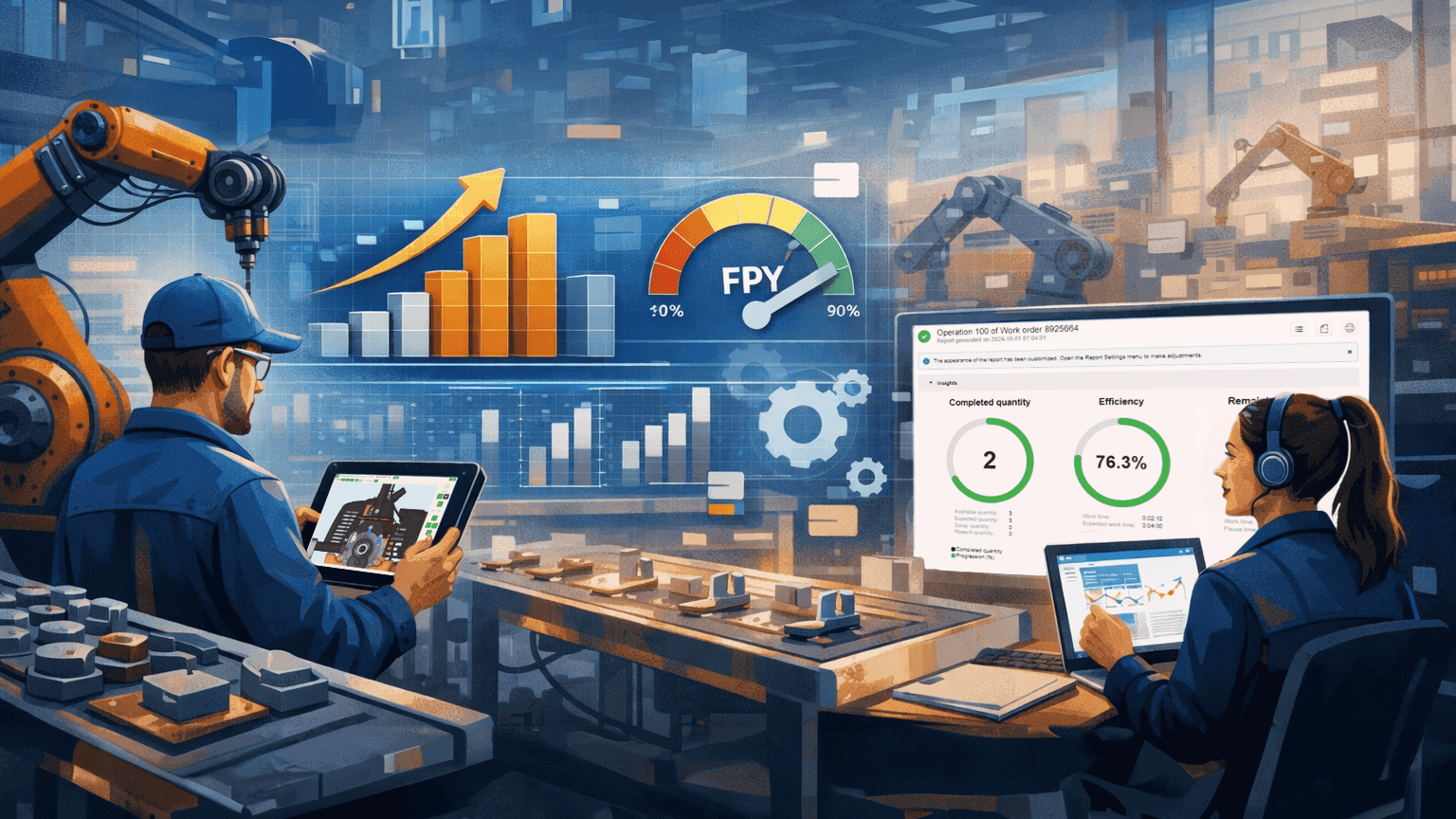
1. First Pass Yield (FPY) - Quality Success on the First Try
What it measures: First Pass Yield (FPY) measures the ratio of units produced correctly the first time without needing any fixing or throwing away.
Why it’s crucial: FPY is a key measure of how well a process is working and how good the quality of the products is. When FPY is high, it means there are fewer mistakes and less wasted materials. Tracking FPY with the right software makes it easier to spot quality issues quickly and helps teams improve their processes over time. In short, a high FPY means a smoother, more efficient production line!
2. Cycle Time - Speed of Production Across Operations
What it measures: Cycle Time, is the total time it takes to produce a single item, including any delays or pauses that happen during the production process.
Why it’s crucial: Keeping an eye on cycle time is essential because it helps you spot any slow points in your production line, known as bottlenecks. When you reduce cycle time, you can produce more items in less time, which means you make better use of your resources and increase overall efficiency. In simple terms, shorter cycle times lead to faster production and more products leaving your facility.
3. Lead Time - Customer Experience Across the Entire Process
What it measures: Lead Time, is the total time it takes from when a customer places an order to when they actually receive it.
Why it’s crucial: Lead time is a key KPI that shows how well a business is managing its production, scheduling, and delivery processes. Shorter lead times mean that customers receive their orders faster, which makes them happier and more likely to return. By tracking lead time, businesses can ensure that their internal operations meet the expectations of their customers, ultimately helping them stay competitive in the market.
4. Takt Time - Production Rhythm to Meet Market Demand
What it measures: Takt Time, is the speed at which products need to be made to satisfy customer demand. Think of it as the heartbeat of your production process, it tells you how fast to work.
Why it’s crucial: Takt time helps businesses understand the right production pace. By comparing how long it actually takes to make a product with the takt time, companies can make sure they’re not making too much or too little. This balance prevents overproduction (which can lead to wasted resources) and delays (which can disappoint customers). In short, it helps ensure that production meets customer needs efficiently.
5. Productivity - Output vs. Input
What it measures: Productivity looks at how much work or products are created compared to the resources used, like the number of hours employees work or the time machines run.
Why it’s crucial: Knowing about productivity helps leaders make smart choices about hiring, managing resources, and deciding when to use technology to automate tasks. With today’s modern tools, it’s easier to track productivity in specific parts of a process, allowing for fair comparisons and better performance improvements. This insight leads to more effective and efficient operations.
6. Work Order Status & Throughput - Process Visibility Across Orders
What it measures: Real-time status of Work Order Status & Throughput, showing whether they are planned, in progress, or completed. It also monitors how well different tasks within each order are progressing.
Why it’s crucial: Knowing the status of each work order is essential for managers. It allows them to adjust schedules and respond to any potential delays, ensuring that everything runs smoothly. With improved reporting tools, managers can quickly see how many orders are moving through the system and how efficiently work is being completed. This connection between real-time activity and long-term planning helps organizations operate more effectively.
7. Labour Productivity
What it measures: Labour Productivity measures how much work is done based on the number of hours employees put in. Essentially, it helps us see how efficient our workforce is.
Why it’s crucial: is especially useful for manufacturers because it helps them understand how well their employees are performing. By looking at this number, companies can identify areas where employees might need extra training or where they need to hire more staff. Additionally, using digital work instructions can make it easier for new employees to get up to speed and ensures that everyone follows the same processes. This can lead to an overall boost in productivity, meaning more work accomplished in less time!
8. Remaining Time Predictions - Forecasting Completion
What it measures: Remaining Time Predictions metric estimates how much time is left to finish a task or operation based on how things are currently going. Essentially, it is a predictive metric which factors in the current efficiency and the time it will take to finish the task or operation.
Why it’s crucial: Knowing the estimated remaining time is important because it helps managers make quick decisions on how to use resources effectively. For example, if they see that a task is taking longer than expected, they can address any issues right away, reallocate resources, or adjust priorities. This proactive approach gives them a significant edge over simply relying on fixed schedules or spreadsheets that don’t account for real-time changes.
9. Production Downtime
What it measures: ProductionDowntimeThis KPI measures how long production lines are not operating. This could happen for various reasons, like maintenance work, switching from one product to another, or unexpected issues that stop the production process.
Why it’s crucial: Reducing downtime is crucial for increasing overall productivity and keeping the manufacturing process running smoothly. One effective way to achieve this is by using digital work instructions, which can streamline setup and training. This means workers spend less time getting ready to operate the machinery and more time actually producing products, ultimately leading to a more efficient production line.
How to Capture Data for Your KPIs
KPIs are only as good as the data that supports them. In 2026, manufacturers are using various digital systems to collect performance data throughout the production process. The best KPI strategies integrate multiple data sources instead of relying on just one system.
Work Instruction Software
Work instruction software captures data right at the moment work is done. They are the fuel for your manufacturing KPIs. As operators carry out their tasks, the system records important information, such as timestamps, task progress, quality checks, and any input from the operators, all in real time. Since these instructions outline the exact steps to follow, the data collected is well-structured and contextual.
This type of software answers critical questions such as:
- Who performed the task?
- When was each step completed?
- Were quality checks passed?
- What deviations or issues occurred during execution?
- What serial numbers were captured
- What parts were used?
Having this detailed visibility is crucial for KPIs such as First Pass Yield, cycle time, labor productivity, predictions of remaining time, and overall work order status. Unlike manual reporting or data entry done after the fact, this system automatically collects data as work occurs, enhancing accuracy and traceability.
MES (Manufacturing Execution Systems)
Manufacturing Execution Systems concentrate on the flow of production and data from machines. MES systems track the progress of work orders, the condition of machines, production rates, downtime, and scheduling performance across the manufacturing facility. They are great for giving a high-level overview of what’s happening on the production floor.
However, MES data often doesn’t provide the detailed human context behind events. That’s why combining MES data with something like work instructions software (or a system that combines the two), which explains how work was carried out, creates a more powerful tool for analysis.
Read More: Is MES Integration Important?
QMS (Quality Management Systems)
Quality Management Systems are designed to manage compliance, audits, non-conformance issues, and corrective actions. These systems are essential for industries with strict regulations and for long-term quality tracking, but they generally record data only after problems are discovered.
When QMS platforms receive real-time data from work instructions and inspections, they can focus more on being proactive about quality rather than just being reactive after issues arise. This leads to a better feedback loop connecting production execution, quality outcomes, and ongoing improvements.
Connected Devices & Sensors
Connected tools, machines, Programmable Logic Controllers (PLCs), and sensors provide precise in-process quality checks and in-depth data, including cycle counts, torque values, temperature readings, runtime, and downtime events. This data provides modern manufacturers with detailed eDHRs and production histories.
While sensor data shows what connected devices and machines did, combining it with a work instructions software gives a complete picture, enabling leaders to see who operated the machine/device, which instructions were followed, which products were made, and all quality data available. Essentially, this level of integration allows manufacturers to turn raw numbers from their connected tools into actionable insights.
By effectively combining these various data sources, you can improve the accuracy of your KPIs and enhance overall production efficiency.
Understanding & Visualizing KPIs with Business Intelligence Software
Most modern manufacturing platforms provide easy access to operational metrics right within the system. With features like dashboards, reports, and KPIs, you can quickly see what's happening on the shop floor, such as how work orders are progressing, overall productivity levels, quality checks, and completion statuses. This type of reporting helps supervisors and frontline workers make informed decisions.
Manufacturing software, especially digital work instruction platforms, is great at capturing important data when tasks are performed. Through interactive guides, smart forms, and work order tracking, manufacturers can consistently collect data on things like timestamps, quantities produced, quality outcomes, and operator feedback, all in real-time.
However, businesses may desire to supplement their KPIs with a data analytics centric system that allows them to visualize and customize their KPI according to their needs. In this case, Business Intelligence (BI) software is a great option.
Where BI Software Adds Value for Manufacturing KPIs
The real benefit of BI software is that it provides the flexibility to design tailored dashboards, turning complex datasets into visual KPIs that drive faster, more informed decision-making.
- Combine data from multiple sources: Merge operational data with your ERP, quality systems, labor data, and scheduling information to get a full operational picture.
- Build custom KPI dashboards: Create role-specific dashboards for executives, plant managers, and continuous improvement teams, focusing on what matters most to them.
- Analyze trends over time: Instead of just looking at individual reports, BI helps you track patterns and trends, spotting seasonal shifts and long-term improvement areas.
- Compare Performance Across Different Factors: Analyze KPIs by various dimensions like plant location, production line, product type, shift, or team. This helps identify best practices and areas that need improvement.
How Manufacturing Software & BI Work Together
Both manufacturing software and BI play important yet distinct roles:
- Manufacturing software captures and structures the data: Digital work instructions, smart forms, and work order reporting ensure that the data is accurate and directly related to how work was done.
- BI software transforms that data into insights: BI tools takes this data and turn it into valuable insights. It compiles, visualizes, and connects data across different systems, supporting better strategic decision-making.
Why Manufacturing KPIs Matter in 2026
Modern manufacturing success relies on using real-time data from the shop floor and analyzing it strategically. Key Performance Indicators (KPIs) play a big role in this process. When these KPIs are based on accurate data and enhanced with Business Intelligence (BI) tools, companies ca
- Solve problems faster
- Make better planning decisions
- Drive continuous improvement with confidence
Instead of depending on outdated data or disorganized spreadsheets, manufacturers can gain a clear and actionable view of their performance. This approach transforms raw data into lasting operational success.