

Connected Worker Platform vs. Traditional MES: Building a More Agile Shop Floor
Manufacturers today are under pressure to produce more, maintain quality, onboard employees faster, and adapt to increasingly complex production requirements. At the same time, many organizations are still relying on paper instructions, disconnected systems, and tribal knowledge to keep production moving.
That creates a difficult combination: more complexity, fewer experienced workers, and less time to train them.
The Manufacturing Challenges and the Need for Connected Worker Platforms
Many manufacturing problems begin with something deceptively simple. How is knowledge transferred to the person doing the work? If this is dialed in, manufactures can experience quality issues, increased downtime, workforce complacency, and more. Let’s take a look at the specific challenges that can arise. We’ll dive into the solutions afterwards.
Challenge 1: Lack of Standardization
Manufacturing organizations often struggle to maintain consistent processes across operators, shifts, and locations.
Tribal Knowledge, increasingly complex workflows, and employee turnover can all make it difficult to ensure that work is performed the same way every time. Experienced operators may know how to handle exceptions or recognize when something isn't right, but that knowledge can be difficult to transfer when it isn't documented.
An aging workforce and employee turnover can make these knowledge gaps even more significant.
Connected Worker Platforms can help standardize processes while making operator expertise easier to capture, share, and build upon.
Challenge 2: High Costs and Limited Agility
Manufacturers need technology that can adapt as quickly as their operations do. However, large manufacturing systems can require significant investments in implementation, customization, and ongoing maintenance.
For manufacturers with changing production requirements, adding new workflows, or adapting existing processes shouldn't require lengthy development cycles or major system changes.
A more agile approach allows manufacturers to introduce digital processes where they are needed without requiring an entire production system to be reconfigured.
Challenge 3: Inflexible Workflows
Modern manufacturing rarely follows a single, fixed process. Operators may need to adjust procedures based on product variations, customer requirements, production orders, equipment, or unexpected conditions on the shop floor.
When workflows are too rigid, operators can end up working around the system rather than with it.
Connected Worker Platforms can provide more flexible, operator-focused workflows that adapt to different tasks and production scenarios while still maintaining process consistency.
Challenge 4: Poor Frontline Usability
Manufacturing technology is only useful if the people performing the work can actually use it effectively.
Operators shouldn't have to navigate complicated interfaces or work through information designed primarily for management or administrative users just to find the instructions they need.
Frontline workers need clear, accessible information that supports them while they are performing a task. A worker-centric approach puts usability at the center of the digital experience, helping operators access the right information without adding unnecessary complexity to their work.
Challenge 5: Difficulty Capturing Unstructured Data
Not all valuable manufacturing information comes in the form of structured production data.
Operator observations, quality notes, photos, comments, and other forms of unstructured data can contain valuable insight into what's actually happening on the shop floor. Yet this information can be difficult to capture and connect to existing manufacturing systems if your system is not built for this reality.
Giving frontline workers simple ways to document and share this information can help manufacturers turn everyday observations into actionable knowledge.
Challenge 6: Limited Real-Time Collaboration
Manufacturing problems often require collaboration between operators, supervisors, engineers, quality teams, and other departments.
When information is spread across paper documents, disconnected systems, emails, or individual conversations, it can take time to get the right information to the right person.
Real-time collaboration tools can help teams share updates, identify issues, and respond to problems more quickly, creating a more connected shop floor.
Transform Manufacturing Challenges into Connected Workflows
These challenges point to a common need: manufacturers need technology that connects people, processes, and production data without creating additional complexity for the frontline workforce.
Traditional MES platforms remain valuable for managing production processes and operational data.
However, Connected Worker Platforms can complement these systems by focusing specifically on the human side of manufacturing, including how workers access instructions, capture knowledge, complete workflows, and collaborate on the shop floor.
The question isn't necessarily whether manufacturers need an MES or a Connected Worker Platform. For many organizations, the opportunity is understanding where each technology fits, which is more valuable for your organization, and how they can work together.
Read More: Capturing Tribal Knowledge for Nidec.
Traditional MES vs. a Connected Worker Platform
Manufacturing Execution Systems have traditionally been used to provide production visibility, traceability, scrap tracking, and other manufacturing management capabilities.
However, traditional MES platforms can also involve significant implementation, maintenance, upgrades, and scaling requirements.
A connected worker platform like VKS takes a different approach with a lightweight MES architecture focused on connecting operators, instructions, production data, and shop floor systems.
| Feature | Traditional MES | Connected Worker Platform |
|---|---|---|
| Primary Focus | Managing production data and equipment. | Guiding and capturing data from human operators. |
| Implementation Time | Months to years; requires heavy IT involvement. | Days to weeks; agile deployment. |
| Agility | Rigid workflows tailored to large-batch consistency. | Flexible workflows adaptable to high-mix production. |
| Frontline Usability | Complex interfaces built for engineers/management. | Intuitive, visual interfaces built for floor workers. |
Traditional MES platforms often focus heavily on managing production information. A connected worker platform can bring that information directly into the operator's workflow.
Measurable Results
When standardized instructions are combined with real-time data collection and connected devices, manufacturers can move from simply documenting processes to understanding what is actually happening on the shop floor.
Manufacturers can also benefit from improved employee flexibility, reduced onboarding and training time, and greater standardization across the shop floor.

Pro Tip: Start With Your Most Critical Process: You don't have to digitize every process at once. Start with an operation where inconsistent execution, training time, quality issues, or missing production data are already creating measurable problems. Once the process is standardized, the same approach can be expanded to additional workstations and operations. !
Already Have an MES? You Don't Have to Start Over.
Replacing an existing MES isn't always practical or necessary.
Many manufacturers already have systems responsible for production planning, ERP, scheduling, inventory, or other enterprise functions.
While scaling up a connected worker platform can fulfill the duties of an MES, it can also work alongside and enhance the capabilities of your shop floor with an existing MES. This is undoubtedly a more agile solution than requiring manufacturers to completely replace their existing infrastructure.
How a Connected Worker Platform Works Alongside Legacy Systems
Through its API capabilities, an existing system can launch VKS instructions based on production information.
For example, an MES can provide an operation number, guidebook ID, and other information that can be used to launch the appropriate VKS workflow.
This allows manufacturers to maintain their existing systems while adding a more operator-focused layer to the production process.
Pro Tip: Connect Systems Around the Operator: When evaluating manufacturing software, ask: "Where does the operator actually interact with this information?" A system can contain valuable production data, but if operators have to leave their workflow, search for information, or manually transfer data between systems, there's still friction. !
How to Build a Digital Foundation
A connected worker platform provides different levels of functionality so manufacturers can build their digital shop floor based on their operational needs.
The system is easy to scale.
Step 1. Visual Work Instructions
VKS Lite provides the foundation for creating, maintaining, and controlling digital work instructions.
Manufacturers can:
- Create digital SOPs and work instructions
- Add visual annotations using a no-code, drag-and-drop interface
- Control document versions and approvals
- Maintain document history
- Create reusable templates
- Make mass updates across multiple instructions
This gives operators access to standardized instructions while giving supervisors greater control over how those instructions are created and maintained.
Pro Tip: Build instructions for the operator, not the engineer: A technically complete instruction isn't necessarily an easy-to-follow instruction. Use concise steps, clear visuals, and only the information an operator needs at that point in the process. !
Read More: A Practical Guide to Becoming an SOP Expert.
Step 2. Operator Guidance, Data & Intelligence
Once instructions are digital, manufacturers can go a step further by collecting information directly within the workflow.
VKS Pro adds capabilities for:
- Digital checklists
- Automatic record-keeping
- On-the-spot validation
- Production reports
- Exportable data through PDF, Excel, or API
Instead of completing a paper checklist and entering information into another system later, operators can record information directly within the digital workflow.
This creates a more complete picture of what happened during a production run.
Step 3. Tool & Device Integration
Modern manufacturing doesn't happen in isolation.
Tools, machines, sensors, test benches, databases, and other devices can all generate information that can be useful during production.
VKS Edge extends standardization and data collection into the connected shop floor through ToolConnect IoT, I/O Connect, and DataConnect.
Torque Tools
ToolConnect can communicate with connected tools and controllers to help manufacturers:
- Send program information to tool controllers
- Capture and validate torque values
- Automatically advance instructions based on tool use
- Lock out tools when process requirements aren't met
This creates a direct connection between the instruction the operator is following and the tool performing the work.
Devices & Machines
IO Connect connects VKS with devices such as:
- PLCs
- Pick-to-light systems
- Vision systems
- Cobots
- Machines and other integrated devices
Manufacturers can validate device operations, capture sensor data, record cycle counts and inspection results, and automatically advance instructions based on machine or device activity.
Step 4. Databases & Database-Driven Equipment
DataConnect extends connectivity to databases and database-driven equipment.
It can be used to:
- Connect to test benches
- Integrate label printing software
- Validate tool calibration
- Receive pass/fail signals
- Configure workflows around external data
Together, these capabilities help transform work instructions from static documentation into an active part of the production process.
Solution in Action: What Does a Connected Worker Platform Look Like?
Imagine an operator beginning a machine setup.
Instead of searching through a binder or navigating several disconnected systems, the operator can:
- Scan a QR code
- Log in
- Launch the digital instructions
- Follow standardized setup steps
- Advance the instructions without touching the screen
- Interact with connected tools and devices
- Record required production data
- Validate results before continuing
The instruction becomes more than a document. It becomes a digital interface between the operator, the process, and the systems supporting production.
This is where the concept of the connected worker becomes particularly important.
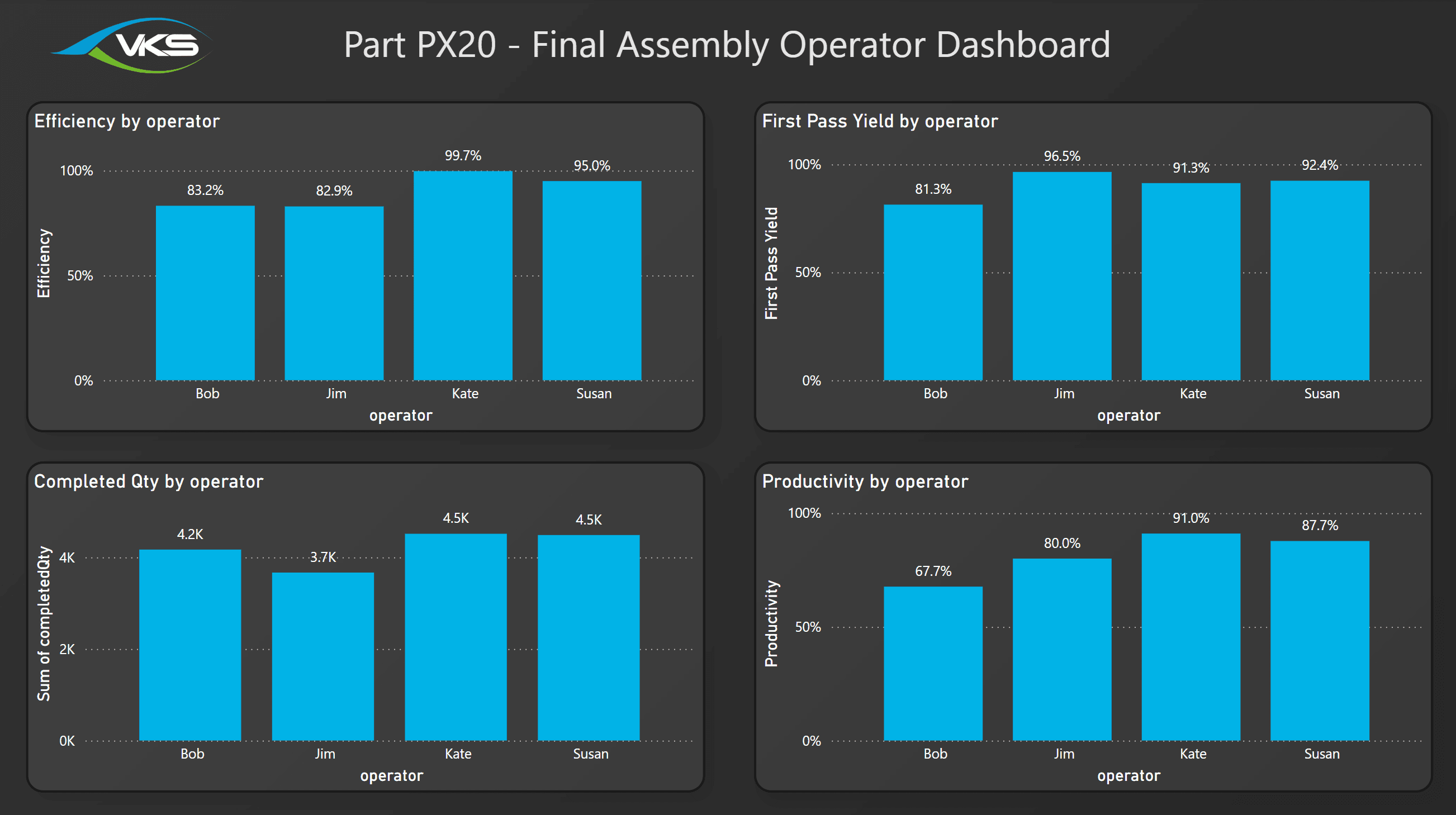
Collecting Shop Floor Data & Analyzing Actionable Insights
Collecting production data is valuable. Understanding what that data means is even more useful.
A connected worker platform can connect shop floor data with BI tools, allowing manufacturers to automatically compile and analyze the data they collected from their shop floor, such as:
- Efficiency by operator
- First Pass Yield
- Completed quantity
- Productivity
- Production performance
- Quality metrics
- Operator feedback
- Time studies
This creates an opportunity to move from "What happened?" to "Why did it happen?"
That distinction becomes increasingly valuable and worthwhile as the industry sees a vast amount of collected data go unanalyzed.
The Future: AI-Powered Shop Floor Insights
FloorIQ: AI Insights & Intelligence
VKS is developing FloorIQ, which brings AI-powered insights and auto-analysis directly into the shop floor experience.
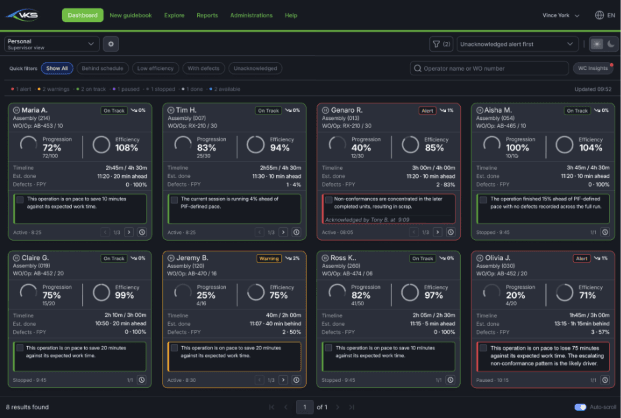
Each dashboard card can include a collapsible insight section generated by the VKS AI insights engine.
These insights aren't limited to problems.
When production is performing well, the system can recognize strong performance and improvements. When something requires attention, it can identify potential issues and provide additional context.
For example, a production card could indicate that an operation is currently running behind its expected completion time and connect that delay with recorded non-conformances.
This type of contextual information can help supervisors spend less time searching through data and more time understanding what requires attention.
AI-Powered Video to SOP Conversion
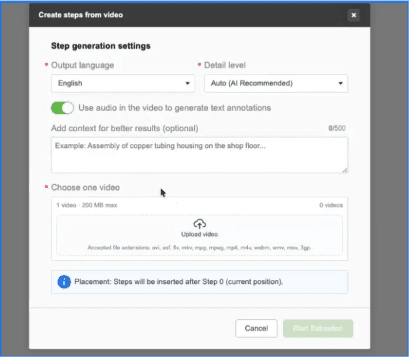
AI is also making it easier to create standardized documentation from the get go.
VKS is developing a Video to SOP conversion technology, which can transform raw video recordings into structured, step-by-step instructions.
The technology can use:
- Visual information from the video
- Audio transcripts
- Adjustable detail levels
- Multimodal text generation
- Editable VKS guidebooks
A supervisor could record an experienced employee performing a process, upload the video, and generate a baseline set of instructions which can be reviewed and finalized.
This provides another way for manufacturers to capture practical knowledge before it disappears from the organization.
The Connected Shop Floor
For many manufacturers, the Connected Shop Floor is about putting better information, tools, and advanced technology directly into the hands of the people performing the work.
That means:
Standardize the process. Create clear digital instructions that capture institutional knowledge.
Connect the workflow. Bring tools, machines, sensors, databases, and enterprise systems into the operator experience.
Capture the data. Record production information where the work happens.
Understand performance. Use dashboards and analytics to identify trends and opportunities.
Build for what's next. Use technologies such as AI to make creating instructions and interpreting shop floor data easier.
The result is a manufacturing environment where people, processes, machines, and data work together instead of operating in separate systems.
Where Does Your Manufacturing Operation Go From Here?
The path toward a connected shop floor doesn't need to happen all at once.
For some manufacturers, the first step may be replacing paper SOPs with digital work instructions. For others, it may be connecting torque tools, PLCs, test benches, or existing enterprise systems.
The important part is creating a foundation that can grow with the operation.