


Standard Operating Procedures (SOPs) are the backbone of consistent, high-quality manufacturing. Whether you're assembling complex products, conducting quality inspections, or training new employees, well-designed SOPs ensure everyone follows the same proven process.
Yet many organizations struggle with SOPs that are outdated, difficult to understand, or ignored altogether.
So, what separates an average SOP from one that truly drives operational excellence? It comes down to becoming an SOP expert; someone who knows how to create, maintain, and continuously improve standardized work.
In this guide, we'll explore what makes an effective SOP, the skills required to create good SOPs, common mistakes to avoid, and how digital work instructions help transform SOPs into living documents that improve every day.
First off, what is an SOP?
Standard Operating Procedure (SOP) defines the best way to complete a task safely, consistently, and efficiently.
In manufacturing, SOPs help organizations:
- Standardize production processes
- Reduce errors and rework
- Improve product quality
- Train employees faster
- Meet regulatory requirements
- Capture institutional knowledge
- Support continuous improvement initiatives
Rather than relying on tribal knowledge tribal knowledge or memory, SOPs ensure every operator has access to the same information every time a job is performed.
Why SOP Expertise Matters More Than Ever
Manufacturing is becoming increasingly complex.
Today's operations often involve:
- High-mix, low-volume production
- Frequent engineering changes
- Labor shortages
- Faster product launches
- Strict quality standards
Without effective SOP management, these challenges quickly lead to inconsistent processes, quality defects, longer training times, and production delays.
An SOP expert doesn't simply write procedures; they create methods that allow people to perform at their best.
The Qualities of an SOP Expert
1. They Know the Process Inside and Out
Great SOPs begin with understanding the work. Before you can document a process, you need to understand how it is actually performed on the shop floor.
So how do SOP experts get this knowledge?
There is only one way: being on the shop floor.
Many SOP experts start by gaining hands-on experience as operators themselves. Firsthand knowledge provides valuable insight into the challenges, variations, and best practices involved in completing a task. Even if you don't perform the job yourself, spending time alongside experienced operators can help you understand what makes a process successful.
But don’t fret if you haven’t spent years as an operator. Another effective way to build this knowledge is by regularly being on the shop floor. One effective method is by conducting a Gemba walk.
A Gemba walk involves observing work where it happens, speaking with the people performing the task, and identifying opportunities to improve safety, quality, and efficiency. Rather than relying on assumptions, you gain a clear understanding of the real process and the factors that influence it.
As you observe the work, pay attention to:
- Process variations
- Common mistakes
- Safety risks
- Quality checkpoints
- Best practices
- Opportunities for improvement
The goal isn't to document how people think the process works. It's to document how the work is actually performed and identify the most effective, repeatable method that can be standardized for everyone.
Read More: How to Do a Gemba Walk.
Learn how observing work at the source can help you identify improvement opportunities, engage operators, and create more accurate, effective SOPs.
2. They Write for the Operator’s Perspective
One of the biggest mistakes companies make is that they don't ask one crucial question: Who am I writing these SOPs for?
Too often, SOPs are written from a manager's, engineer's, or quality professional's perspective. While these individuals may understand the process, they are not the ones performing the work every day. As a result, procedures often become overly technical or filled with industry jargon.
An effective SOP should be written with the operator in mind. Operators need clear, practical guidance that helps them complete the task safely, accurately, and efficiently. If employees have to stop and interpret complicated language or search for missing information, the SOP is no longer supporting the work. Instead, it becomes another obstacle in the process.
When writing an SOP, ask yourself:
- What is the skill level of the employee?
- Is each step clear and actionable?
- Are technical terms explained where necessary?
- Would an image or video communicate this step more effectively than text?
By answering these questions, operators will receive instructions that are clear, concise, visual, easy to follow, and accessible.
| Instead of writing: | Write: |
|---|---|
| Install the fastening component utilizing the approved torque methodology. | Install the M8 bolt and tighten it to 22 Nm using the calibrated torque wrench. |

Pro Tip: Write SOPs for the person performing the task, not the person reviewing it. Use simple language, clear visuals, and concise instructions that operators can quickly understand and follow on the shop floor. !
3. They Use Visuals Wherever Possible
Operators often need to absorb information quickly while performing a task. Humans process images much faster than text. Long paragraphs of text can slow them down, increase the chance of misinterpretation, and make it more difficult to find the information they need at the moment they need it.
Visuals help simplify complex instructions by showing operators exactly what to do and what the expected result should look like. Instead of interpreting written descriptions, employees can quickly reference an image, diagram, or video to confirm they are completing the task correctly. This improves consistency, reduces errors, and helps shorten the learning curve for new operators.
High-quality SOPs include:
- Photos
- Diagrams
- Videos
- Annotations
- Call-outs
- Interactive elements
Visual instructions help operators understand exactly what "good" looks like by providing a clear standard. Rather than imagining the desired result based on a written description, operators can compare their work to an image or video and quickly identify whether they are completing the task correctly. This type of SOP leads to greater consistency, improved quality, and fewer defects.
This visual approach to SOPs becomes especially valuable for:
- Complex assemblies
- Quality inspections
- Machine setup
- Maintenance procedures
- New employee onboarding
Pro Tip: If an operator has to stop and reread a step, your SOP may be too complex. Adding photos, videos, or annotated images can often communicate instructions more effectively than paragraphs of text. !
4. They Standardize the Format
SOP experts develop a standard structure across every procedure for one powerful reason.
Consistency makes information easier to find and follow. When every SOP uses the same layout, operators know exactly where to look for safety precautions, required tools, quality checks, and step-by-step instructions. This reduces the time spent searching for information, minimizes confusion, and makes it easier for employees to move between different tasks without having to learn a new document format each time.
Great SOPs share the same key features. The format may be different across companies and platforms, but they all need to have the information listed below.
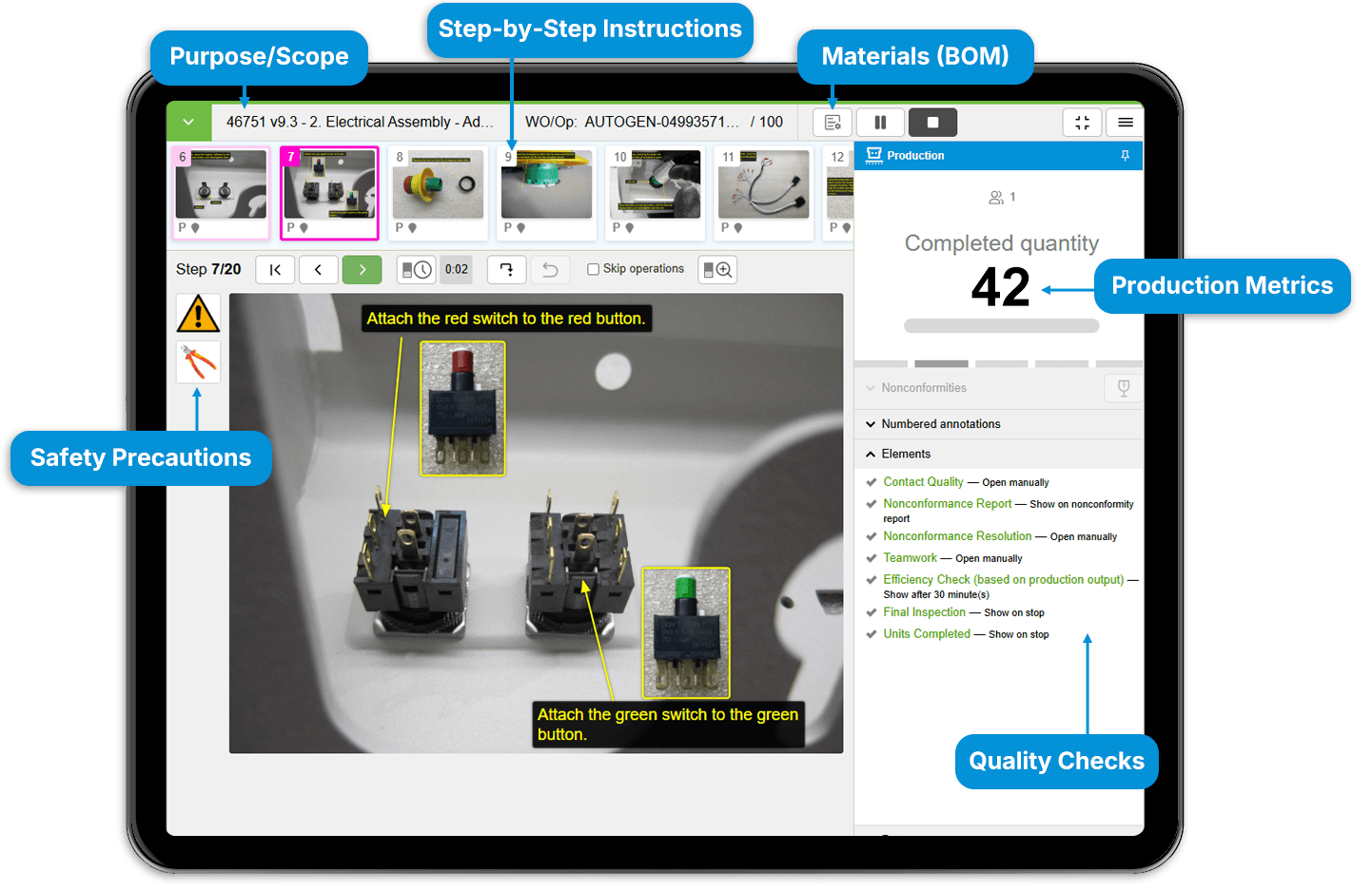
Purpose: This gives a name which explains why the SOP exists and the objective of the procedure. It provides context so employees understand the goal of the task, whether it's to ensure product quality, maintain safety, or standardize a specific process.
Scope: Defines where and when the SOP applies. This can include the department, production line, machine, product family, work order number, or specific situations where the procedure should be followed.
Required tools: Lists all tools, equipment, software, or measuring devices needed to complete the task successfully. This includes calibration or specification requirements to ensure operators use the correct equipment.
Safety precautions: Outlines any hazards, required personal protective equipment (PPE), lockout/tagout procedures, ergonomic considerations, or other safety measures that must be followed before and during the task.
Materials: Identifies the raw materials, components, consumables, or parts required to perform the procedure (BOM). Part numbers, quantities, or specifications can also be included to reduce errors.
Step-by-step instructions: Provides clear, sequential instructions that guide operators through the task from start to finish. Using simple language, visuals, and specific measurements helps ensure consistency and reduces ambiguity.
Quality checks: Specifies inspection points, measurements, acceptance criteria, or verification steps that confirm the work meets quality standards before moving to the next stage.
Production Metrics: This gives the operator at-a-glance awareness and enables the operator to know exactly where they stand without breaking their rhythm.
Troubleshooting: Offers guidance for resolving common issues that can occur during the process, including likely causes, corrective actions, and when to escalate problems to a supervisor or maintenance team.
When every SOP follows the same format and has the right information, employees spend less time searching and more time doing the work.
5. They Keep SOPs Current
An outdated SOP is sometimes worse than having no SOP at all.
Processes evolve constantly, so the challenge is to keep up with:
- Engineering changes
- New equipment
- Updated materials
- Continuous improvement
- Customer requirements
An SOP expert establishes regular review cycles to ensure documentation always reflects the current best practice.
Version control and approval workflows help prevent outdated procedures from reaching the production floor.
Version control helps organizations track changes made to an SOP over time, creating a clear record of what was updated, when it was changed, and who made the changes. This ensures operators are always working from the latest approved procedure while maintaining traceability for audits and continuous improvement efforts.
Approval workflows establish a structured review process before changes are published. By requiring designated stakeholders, such as supervisors, engineers, or quality managers, to review and approve updates, organizations can verify that procedures are accurate, complete, and ready for use.
Together, version control and approval workflows help prevent outdated or unapproved procedures from reaching the production floor, ensuring operators always have access to the most current and reliable instructions.
Common SOP Mistakes to Avoid
Even experienced organizations can make mistakes when creating SOPs. While these errors may seem minor, they can lead to confusion, inconsistent work, longer training times, and avoidable quality issues.
Some of the most common mistakes include:
- Too Much Text
On a busy shop floor, operators often need to find information quickly. If they have to sift through large blocks of text to locate a single instruction, they are more likely to skip steps or overlook important details.
The Fix: Break information into short, actionable steps. Use bullet points, numbered lists, and visuals to make instructions easier to scan and understand.
- Missing Visual References
Text alone can leave room for interpretation, especially when describing complex assemblies, machine setups, or quality requirements. Two operators may interpret the same instruction differently, leading to inconsistent results.
The Fix: Include photos, diagrams, videos, or annotated images wherever possible. Visual guidance helps operators understand exactly what each step should look like and promotes greater consistency across the workforce.
- No Operator Input
SOPs are often written by engineers, supervisors, or quality teams without consulting the people who perform the work every day. As a result, procedures may overlook practical challenges, include unnecessary steps, or fail to reflect how the process is actually carried out.
The Fix: Involve operators throughout the SOP creation and review process. Their firsthand experience helps ensure procedures are practical, accurate, and easy to follow while also encouraging greater adoption on the shop floor.
- Difficult Access
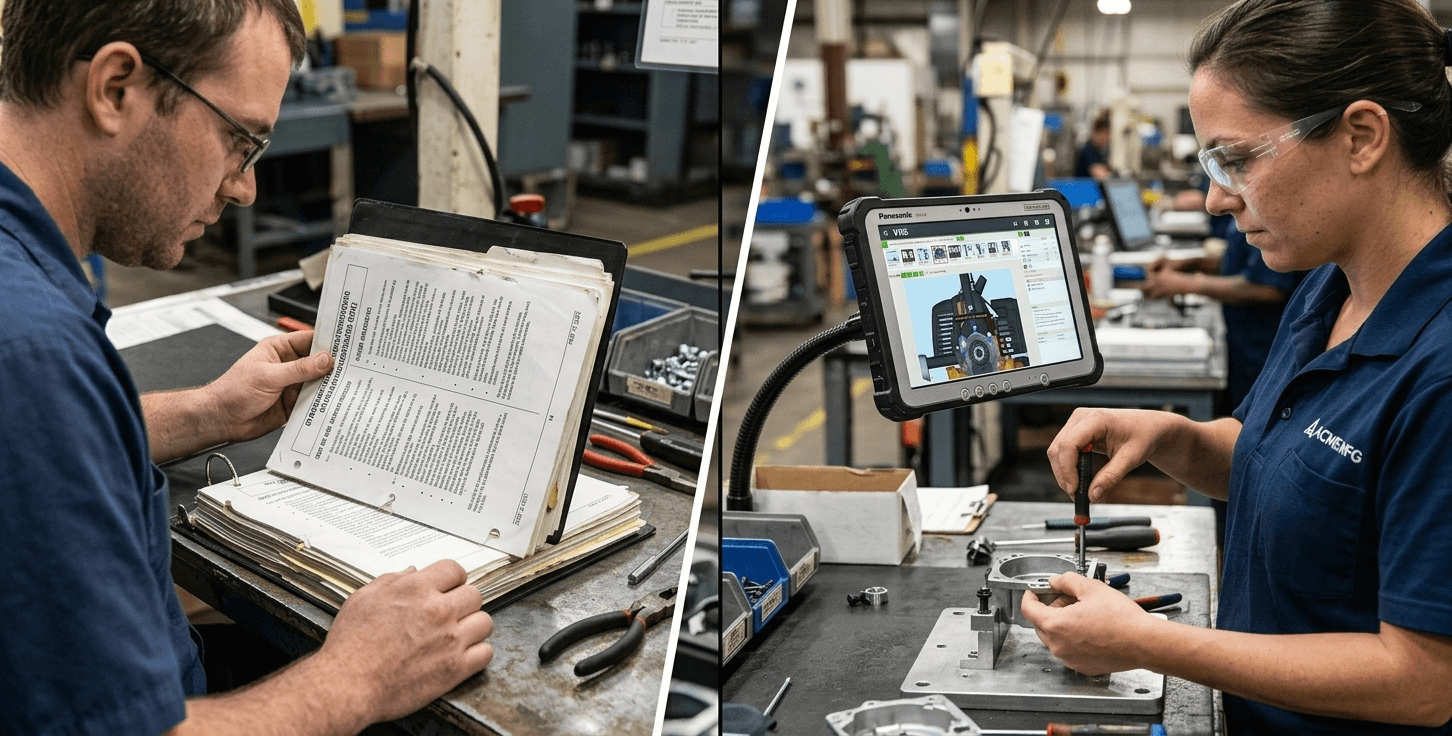
Even the best-written SOP won't be effective if employees can't easily find it. When procedures are stored in binders, scattered across shared folders, or saved in multiple versions, operators may waste time searching for information or accidentally use outdated instructions.
The Fix: Make SOPs available at the point of use through a centralized, easy-to-access system. Providing operators with the latest approved instructions exactly when and where they need them improves compliance, efficiency, and consistency.
- No Ownership
Without clear ownership, SOPs can quickly become outdated or inconsistent. Changes to equipment, processes, or quality requirements may never be reflected in the documentation, leaving operators to rely on outdated procedures or informal workarounds. Over time, this can reduce trust in the SOPs themselves and increase the risk of errors.
The Fix: Assign an owner to every SOP who is responsible for reviewing, updating, approving, and continuously improving the document. Clear ownership helps ensure procedures remain accurate, relevant, and aligned with current operations.
Read More: 8 Work Instruction Problems Solved with VKS.
Digital SOPs vs. Paper SOPs
Paper SOPs served manufacturing well for decades, but today's production environments demand greater flexibility. And sadly, paper doesn’t cut it.
| Paper SOPs | Digital SOPs |
|---|---|
| Static documents | Real-time updates |
| Difficult to revise | Instant version control |
| Limited visuals | Photos, videos, animations |
| Manual distribution | Automatic and immediate deployment |
| Hard to track usage | Usage analytics |
| Prone to outdated copies | Always current |
Digital SOPs help ensure operators always access the latest approved instructions while making updates significantly easier to manage.
Pro Tip: The best SOPs don't just tell operators what to do. They guide them through each step with visuals, collect production data, and adapt as processes evolve. Digital work instructions make it easier to keep procedures accurate, accessible, and up to date. !
Building SOP Expertise Across Your Organization
Creating one great SOP isn't enough. Creating one SOP expert isn’t enough.
Thankfully, digital SOP platforms and work instruction software makes it easy for teams to work collaboratively, promote compliance, and ensure SOPs are up to date.
Create templates: Develop standardized templates that ensure every SOP follows the same structure, format, and level of detail. Consistent templates make processes easier to create, navigate, and update.
Train process authors: Equip the employees responsible for writing SOPs with the skills and tools to create clear, accurate, and easy-to-follow documentation. Training should emphasize writing for the operator, using visuals, and maintaining consistency across all procedures.
Establish review processes: Implement a structured review process to verify that SOPs are accurate, complete, and reflect current best practices before they are published or updated. Reviews should involve subject matter experts and key stakeholders.
Define approval workflows: Create a formal approval process that identifies who is responsible for reviewing, approving, and publishing SOPs. This helps ensure only validated and up-to-date procedures are available to operators.
Perform regular audits: Periodically evaluate SOPs to ensure they remain relevant, compliant, and aligned with current production processes. Regular audits help identify outdated information and opportunities for improvement.
Encourage operator feedback: Invite operators to share suggestions, report unclear instructions, and identify process improvements. Since they perform the work every day, their feedback is invaluable for keeping SOPs practical and effective.
Measure SOP effectiveness: Track metrics such as training time, error rates, rework, quality performance, and operator compliance to evaluate how well SOPs support production goals. These insights help identify where procedures can be refined for even better results.
When SOP creation becomes standardized, documentation quality improves across every department.
Read More: What Is Standardized Work? Learn how standardized work helps manufacturers improve consistency, reduce variation, and support continuous improvement.
How Digital Work Instructions Strengthen SOPs
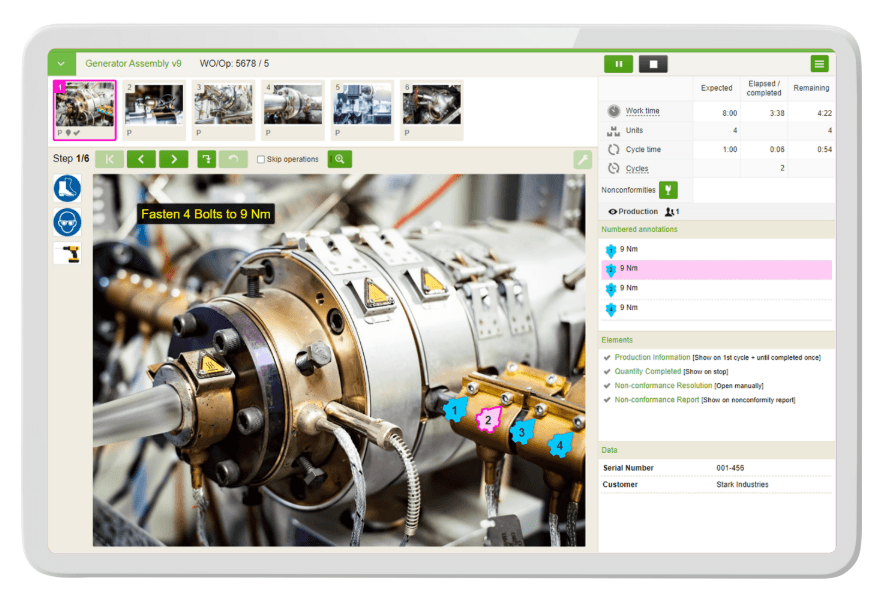
As manufacturing becomes increasingly connected, many organizations are moving beyond static SOP documents to digital work instructions and connected worker platforms.
Digital work instructions and connected worker technology allow manufacturers to:
- Present step-by-step guidance directly at the workstation
- Include images, videos, CAD models, and annotations
- Capture production data during execution
- Integrate quality checks into workflows
- Connect with tools, machines, and IIoT devices
- Automatically update procedures after approval
- Reduce training time for new employees
- Maintain complete version history for traceability
Rather than sitting in a binder, SOPs become interactive guides that support operators throughout every task.
Taking SOPs to the Next Level
Effective SOPs are more than documents. They form the foundation for operational excellence.
When procedures are easy to follow, consistently maintained, and accessible, operators can perform with greater confidence, quality improves, and organizations become more agile in the face of change.
With a digital work instruction platform like VKS, manufacturers can take SOPs beyond static documents by delivering interactive, visual guidance. Real-time updates, built-in quality checks, connected tools, and data collection help ensure every operator is following the right process at every moment.
Whether you're creating your first SOP or modernizing hundreds of existing procedures, becoming an SOP expert means using the right tools to build processes that empower your workforce, improve consistency, and drive smarter manufacturing.
Read More: Learn What are Digital Work Instructions?