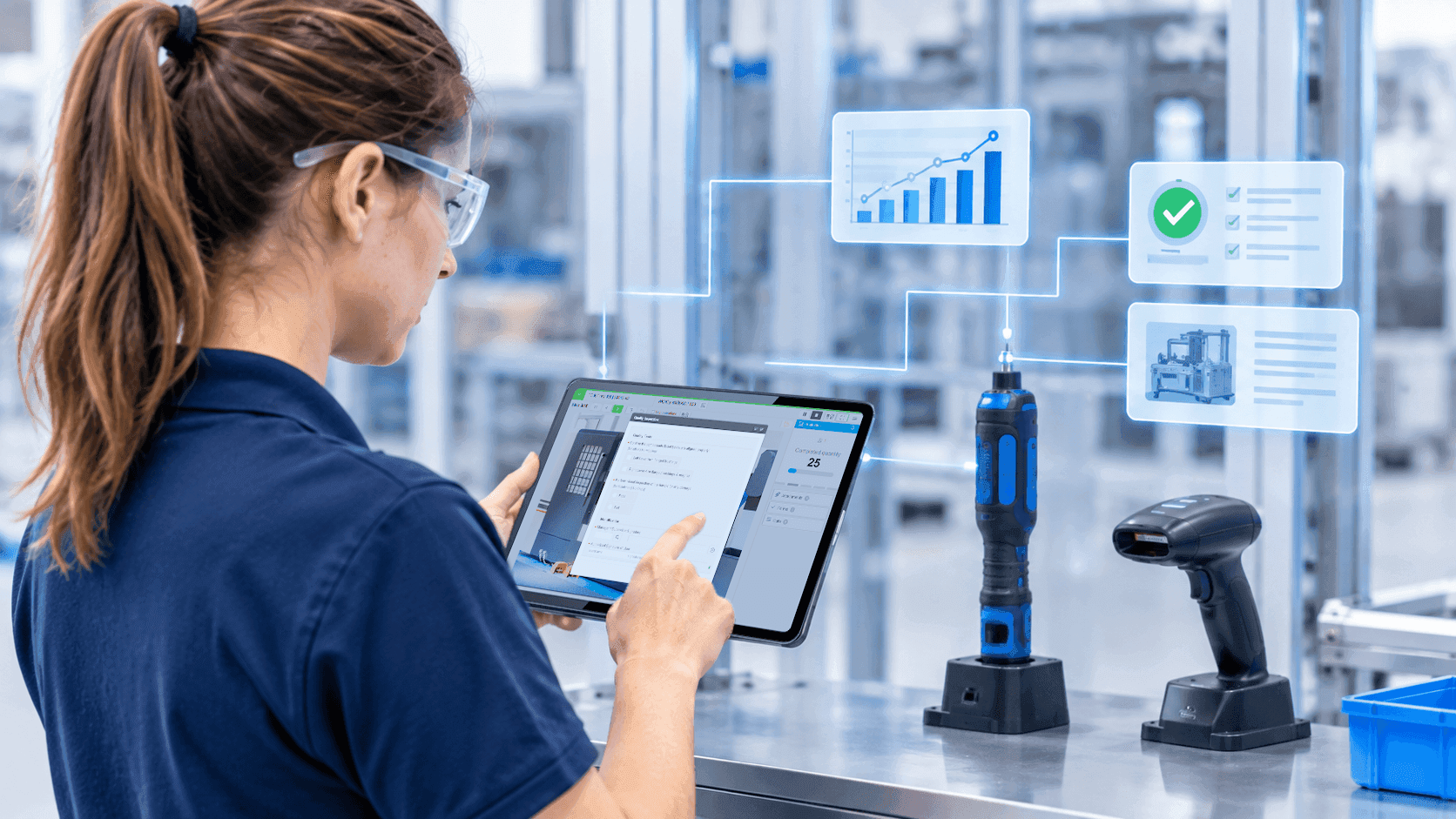


Manufacturers are moving away from paper instructions, static PDFs, and disconnected production systems. One of the key drivers of this change for the industry is digital work instructions.
However, digitizing your instructions is only one piece of a larger connected manufacturing strategy.
This is where the idea of a connected worker comes in.
But what is the difference between digital work instructions and a connected worker platform?
In short:
- Digital work instructions provide step-by-step guidance and enable companies to centralize and control their institutional knowledge.
- A connected worker platform builds on that guidance by linking the worker’s workflow directly to smart tools, machines, sensors, and enterprise systems.
While we’d like to separate these two technologies into two clear categories. However, it's not really that simple, nor is it the whole story. In practice, they exist on the same continuum—digital work instructions serve as the core engine, while a connected worker platform expands that engine across the entire shop-floor ecosystem.
So let’s dispel the confusion!
In this article, we'll explain how the two concepts are related, where they differ, and when a manufacturer needs one instead of the other.
The Role of Digital Work Instructions in Manufacturing

Instead of relying on static PDFs or paper manuals, digital work instructions empower workers with instructions on a computer, tablet, or other connected device.
Modern digital work instructions include:
- Images and videos
- Step-by-step instructions
- Visual inspection steps
- Version history
- Revision control
- Data collection
- Quality checklists
The goals of any digital work instruction software are simple: Give workers the right information at the right time, control the process, and collect data.
Capturing Data at the Point of Work
In manufacturing, data is collected from many different sources; it can include measurements, inspection results, component information, tool data, machine signals, quality records, and operator inputs
The challenge isn't just collecting more data; it’s making sure the right information is captured at the right point in the process and remains connected to the work order, product, operator, and production record it belongs to.
When data is collected separately from the work being performed, manufacturers can lose important context.
A measurement entered into a spreadsheet after a batch has long been complete, for example, has more chances and opportunities to be false. Digital work instructions allow operators to capture information as each step is performed.
For example, a digital workflow enables workers to immediately capture:
- Cycle times
- Completed quantities
- Inspection results
- Serial numbers
- Measurements
- Operator signoffs
- Quality information
This gives manufacturers a clear picture of the shop because data is captured and stored at the right moment. Each data point is linked to a specific part, step in the process, worker, tool, and/or production record.
This also enables quality information to be readily available when it is needed and prevents endless searching through disparate records.
Use Case: Automated & Manual Data Collection
Picture a worker who builds industrial vacuum pumps. She might assemble a batch of five pumps, do her checks, and then sit down later to fill out a paper form with serial numbers and inspection details from memory.
This process can lead to mistakes and make it hard for managers to know what happened during production. However, with a connected worker platform, collecting data can be a natural part of the assembly process.
When it’s time to install the motor on a pump, VKS prompts the operator to record the motor’s serial number. Instead of writing it down to enter later, she uses a barcode scanner to capture the number immediately and accurately.
Since VKS keeps all the production information in one place, it links the serial number to the work order, the specific task being done, the time it was completed, and the worker who did it.
When the operator gets to the quality inspection stage, a quality inspection form pops up in the workflow. This form asks her to enter important inspection details like measurements, pictures, or a supervisor's signature. Once she fills in the necessary information, she can move on to the next step.
Having quality checks and safety verifications built into the process helps guide the worker through the tasks. The operator is reminded to check components in the correct order, while important production and quality details are recorded as she works. This gives manufacturers more accurate records, better traceability, and clearer visibility into how work is being done.
Use Case: Visual Guidance and Point-of-Work Data Capture
Consider a technician assembling an industrial vacuum pump. Relying on paper manuals, distinguishing between similar gasket profiles depends on memory, while motor serial numbers and torque checks are jotted down on a paper traveler to be entered into a spreadsheet hours later.
Digital work instructions turn execution and data collection into a single workflow:
- Visual Guidance: High-resolution images highlight the exact seal orientation, while an embedded video clip demonstrates the proper seating sequence.
- Integrated Traceability: When mounting the motor, the interface prompts the worker to scan its barcode, instantly tying that component's serial number to the active work order and operator ID.
- In-Process Quality Checks: Before moving to the final casing, an inline inspection form pops up requiring the technician to input pressure test readings and submit a digital sign-off.
Instead of recording numbers after the fact from memory, critical production data is validated and captured at the point of work—enforcing quality standards while generating an auditable digital record in real time.
How Digital Work Instructions Evolve Into a Connected Worker Platform & Strategy
Digital work instructions are the foundation of a connected worker strategy, where digital guidance is augmented and enhanced to further empower operators with automated capabilities.
A simple progression would look like this:

Digital instructions provide the interface that workers use to interact with the process. From there, manufacturers can add more connected capabilities. This includes automated hands-free data collection, connected tools/devices, and integrated systems.
The Power of the Connected Worker Platform: The Next Evolution of Digital Work Instructions
A connected worker is a frontline employee who has access to information, tools, systems, and technology while performing their work. Essentially, a connected worker platform provides the opportunity to integrate the worker with their entire manufacturing ecosystem, such as:
- Digital work instructions
- Smart tools
- Machines
- Sensors
- Quality systems
- ERP or MES software
- Digital forms
- Real-time production data
The goal is to give workers the information and tools they need within one connected system. Multiple systems, one interface for the worker.
For many manufacturers, digital work instructions provide an effective way to standardize processes, guide workers through complex tasks, capture important information, and make sure everyone follows the same approved procedures. They can be especially valuable when the main challenge is giving workers clear, consistent instructions at the point of work.
However, a connected worker approach builds on those capabilities by bringing additional tools, machines, systems, and production data into the operator’s workflow.
Instead of only providing instructions, the connected experience can also allow workers to interact with connected equipment, automatically & manually collect data, and access real-time information while they work.
For example, a worker can scan a part or work order to open the correct work instructions. The instructions can guide the worker through each step while collecting inspection information and receiving data from connected tools or devices.
Some companies may primarily need digital work instructions software to standardize and improve how work is performed. Others need real-time data collection and a strong digital thread between their systems and tools like machines, sensors, torque tools, ERPs, and more.
Digital work instructions help answer: How should this job be performed?
A connected worker platform answers the above question and also answers: How can we connect the worker, process, tools, machines, and data so the work can be performed and managed more effectively?
Learn more about Connected manufacturing
Connecting Operators to Machines & Tools
One of the biggest differences between basic digital instructions and a connected worker platform approach is worker-machine connectivity.
In manufacturing, workers often use many tools and systems during their tasks. When machines and tools work separately from the operator’s workflow, they have to enter information by hand and/or switch between different applications to access or interact with them.
This leads to more work and can cause mistakes.
With worker-machine connectivity, the workflow is unified. Information can flow easily between the worker, instructions, tools, and machines.
- Barcode Scanners: Enable users to capture serial numbers and/or launch work instructions quickly and accurately.
- Connected Torque Tools: Send the right parameters to the tool, validate the action performed, and save the results.
- Vision Systems & Test Benches: Automatically perform inspections and record key quality data.
- PLCs (Programmable Logic Controllers): Send a signal to a machine to start the next step.
- Label Printers: Auto-print the correct label with the right information at the right time.
- Sensors: Ensure that all parameters of a machine or room are ready for continued work.
The VKS connected worker platform leverages digital work instructions and these advanced integrations to communicate with outside databases, machines, and tools.
This results in a more connected workflow, where the worker doesn’t have to handle every data exchange manually.
Use Case: Connected Torque Tools
Imagine a worker following digital instructions to install a circuit board onto an enclosure or chassis. This already enables smart standardization and is the first step to taking control of your processes.
But what about error-proofing the process? What about collecting accurate and reliable data?
Connected worker technology connects the instructions to a torque tool that automatically does the following:
- Automatically pushes the required torque setting to the tool
- Validates each application of the tool
- Records the torque value
- Locks the tool when not needed
Now the system does more than provide instructions. It guides the worker, collects data, validates that all specifications are met, and collects and stores the data for later use. And this all occurred behind the scenes in seconds while the worker focused on the physical installation.
Connected Worker vs. Digital Work Instructions: Which Do You Need?
Choosing the right technology depends on your current manufacturing needs and how connected you want your operations to be.
Still having trouble deciding?
The best part is, wherever your choice, you’re not permanently stuck with that decision for all time.
Digital work instructions provide the foundation for a well-developed connected worker platform and strategy. Once processes are digitally standardized, manufacturers can progressively connect their instructions with their tools, machines, and systems as they need.
VKS facilitates workflows where people, processes, equipment and data work together in harmony at every stage of growth and development, from digital work instructions to a fully integrated connected worker platform.